





crochet newborn blanket patterns can carry more than a useful stitch repeat: they can help keep a family memory in your hands. If you have a photograph, an unfinished afghan, or only a few remembered details, you can investigate its texture and plan a smaller blanket without pretending to know more than the evidence shows.
Key Takeaways
- Use a clear image or an actual swatch to investigate an heirloom stitch. Similar textures do not prove an identical pattern.
- For one vintage pattern family, the starting chain is 19n + 18. Five repeats require 113 chains, but the turning chain rule must be stated separately.
- Plan around a flexible, washable fabric and disclose gauge, size, and yardage. A crocheted blanket must stay out of an infant sleep space.
A Grandmother’s Afghan, Remembered Through Its Stitches
A familiar blanket can be a record of the person who made it: the colors they chose, the weight of the yarn, and the rhythm of the stitches. Recreating its texture can be a meaningful project, whether you are making a keepsake for yourself or planning a newborn gift. This article treats the family blanket as a clue, not as proof of a named stitch. The available research does not establish how many people search for simple heirloom style stitches, so the focus here is practical help for readers with a personal reason to look.
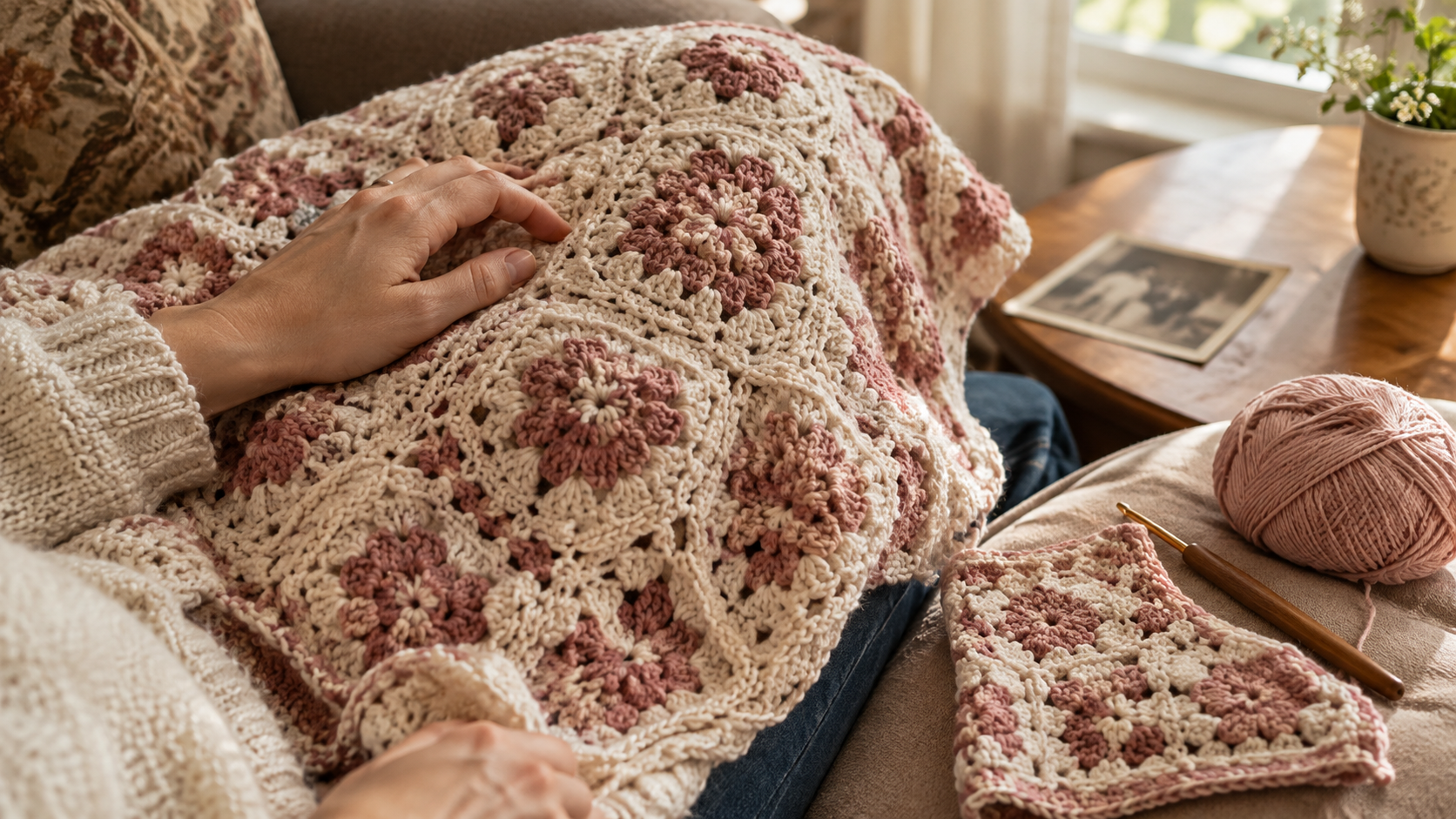
If you have a clear photograph, a small sample, or an unfinished section, those details can help you compare repeats. A written description such as “bumpy and lacy” is less reliable because yarn texture, lighting, repairs, and the reverse side can change how a stitch appears. You can share a photo or memory with other crocheters, but allow room for uncertainty while identifying the pattern.
Can You Identify the Stitch in the Family Blanket?
Begin with a close, well lit photograph of several full repeats. Lay the blanket flat without stretching it, and photograph both sides if possible. Include a ruler or another scale reference. Look for one recognizable motif and follow it upward through several rows. If it moves sideways, the pattern may use offset repeats or shaping. If the blanket has a border, inspect the central fabric separately; a later repair or edging may not belong to the original stitch.
Count the width between matching motifs rather than guessing from color. The available vintage afghan instructions use a starting chain that is a multiple of 19 plus 18, written as 19n + 18. That is a useful clue when testing that particular pattern family, not a universal formula for family afghans. Compare the front and back, and note whether the turning chain seems to form a stitch or simply lift the yarn to the next row. A photograph may not answer that last question conclusively.
When visual identification is uncertain, describe the motif and test a likely stitch family instead of publishing a confident name. A guide to what is yarn can also help explain how fiber, yarn weight, and texture affect the appearance of the sample.
Swatch the Repeat Before You Commit
A small swatch can save hours of unraveling. First, take a flat photograph of the original and mark two matching motifs in the image. Use smooth, contrasting yarn for your test so individual loops are easier to see. Work at least four or five repeats; one repeat alone can be misleading because it may not show how the edges and rows interact.
- Count the stitches across one complete horizontal repeat and record the number.
- Identify the basic actions you can actually see, such as single crochet, taller stitches, clusters, shells, or crossed stitches. Do not infer a precise stitch sequence from a vague photo.
- Make a sample with at least four or five repeats and several rows. Photograph the front and back in similar light to the original.
- Compare the repeat width, row height, texture, holes, and edge behavior. A close visual match is more useful than matching the blanket’s color.
- Only adjust hook size after you are reasonably sure the stitch sequence is right. A different hook changes scale and drape, but it cannot repair a wrongly identified repeat.
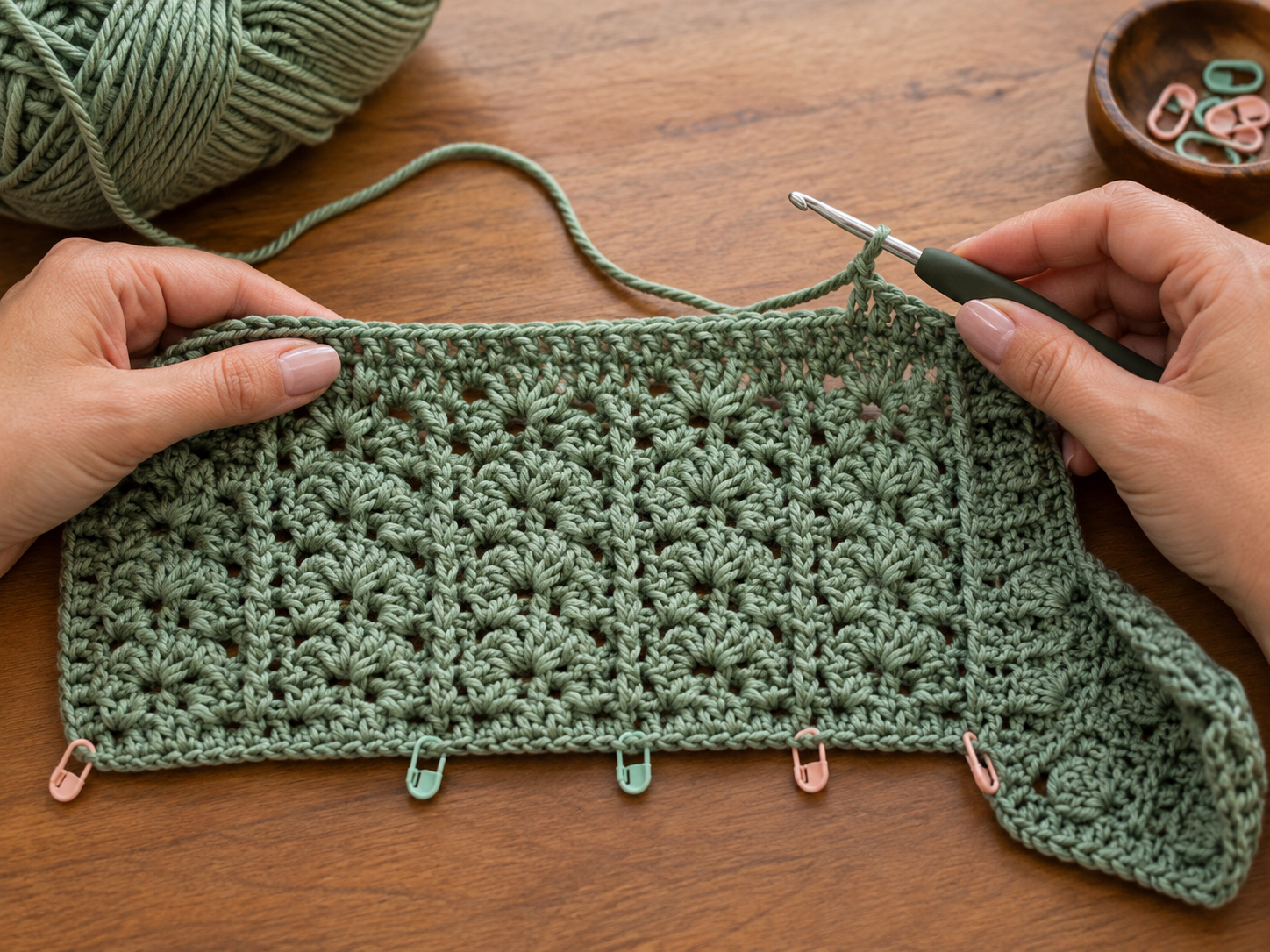
For the finished tutorial, include front and back close ups, a diagram of one complete repeat, and a ruler in the swatch photograph. These visuals are especially helpful for crocheters who are learning to read written patterns. See the site’s guidance on gauge and pattern mistakes for a reminder that stitch size and finished measurements depend on the maker’s tension.
The Pattern Math: Starting Chains, Turning Chains, and Row Counts
If your sample appears to match the vintage pattern family, calculate the foundation chain with the formula rather than adding chains by eye. For five repeats, the arithmetic is 19 × 5 + 18 = 113 chains. This example describes starting chains only. It does not establish how many stitches the first working row contains, where a turning chain belongs, or whether that chain counts as a stitch in the pattern.
In the tutorial you publish, state the turning chain rule explicitly. For example, say whether the chain at the beginning of a row counts as the first stitch, and show where the first and last working stitches go. Then give an end of row stitch count and distinguish the foundation chain, working stitches, pattern repeats, and any stitches added later for a border. The research does not confirm the original afghan’s turning chain method, so do not attribute your chosen rule to the family blanket without evidence.
Use removable markers at the first and last stitch while learning the repeat. Count at the end of each row for the first few rows. If the count changes unexpectedly, stop and locate the missed or added stitch before continuing.
Adapt the Stitch to a Practical Newborn Blanket
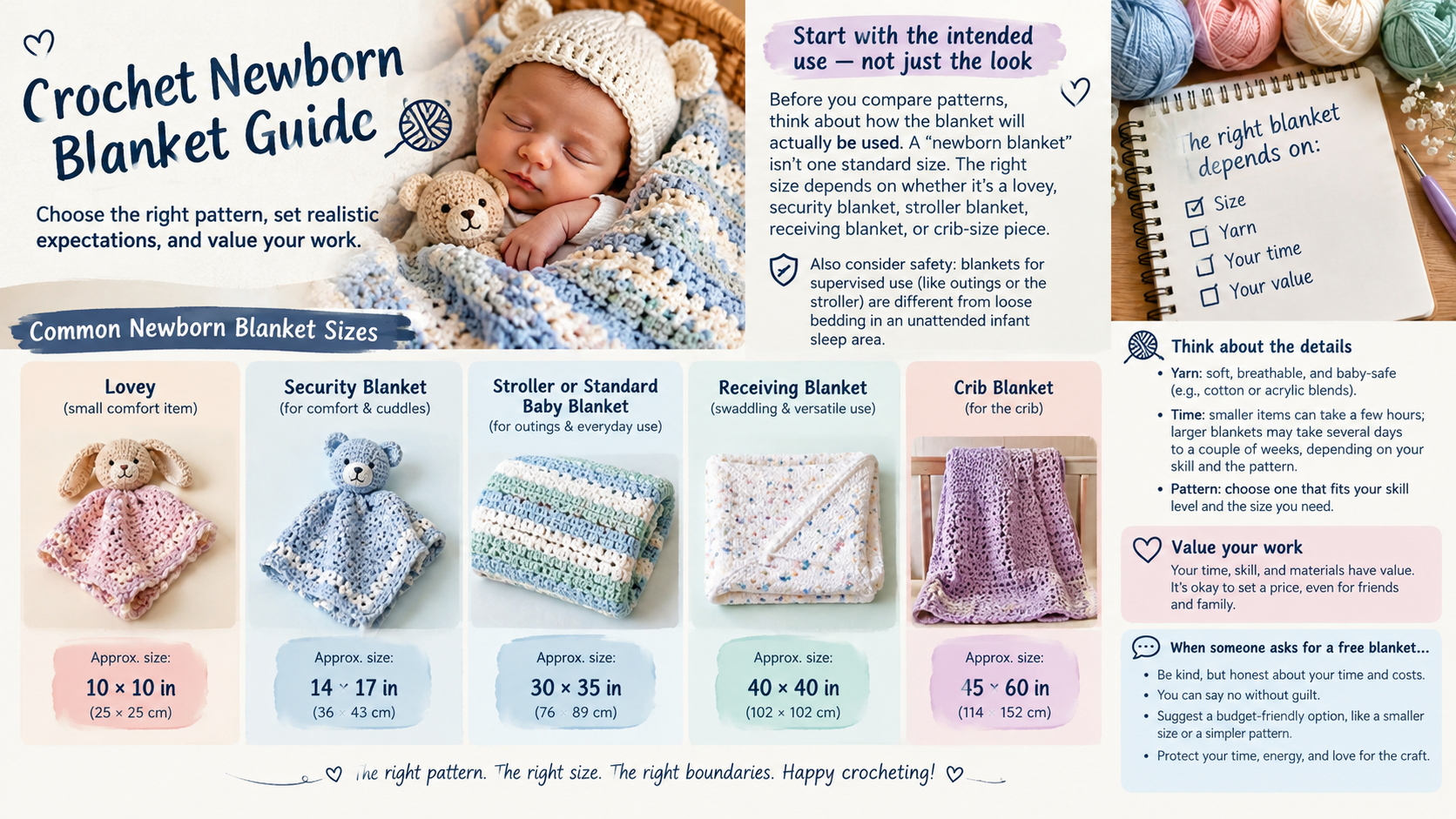
Choose an intended size before calculating repeat count. Approximately 30 × 36 inches is a compact option; approximately 30 × 40 inches is another receiving blanket planning size. These are recommendations, not verified test results for this particular heirloom stitch. Final dimensions depend on gauge, yarn, stitch density, and any border.
A reasonable materials starting point is light worsted or DK through worsted yarn, with a hook in the approximate 4.0 to 5.5 mm range. Treat those as starting ranges, not instructions to skip a swatch. Select a smooth, low shedding yarn that can be washed according to its label. The fabric should fold easily without feeling stiff, overly dense, heavy, or so open that loops snag readily.
Research estimates 900 to 1,400 yards for these approximate blanket sizes, plus a 10 to 15 percent allowance for a border, gauge variation, joining, and finishing. This is not tested yardage for the stitch described here. To improve the estimate, measure the yarn used for a completed swatch, then scale by the blanket area: swatch yardage multiplied by target blanket area divided by swatch area. Add the allowance after that estimate.
The completed pattern should state the measured swatch gauge in stitches and rows per four inches, actual hook size, exact starting chain, repeat count, finished dimensions, and yardage. If you want a clearer guide to fiber choices, link readers to the yarn and fiber guide. Rough planning costs from the research are US$20 to $45 for acrylic, US$30 to $70 for cotton or a cotton blend, and US$5 to $20 for hook and finishing supplies if not already owned. These are planning estimates, not a verified 2026 price survey.
Advanced Analysis and Common Pitfalls
Most frustrating blanket problems start at the edges or in the math. Check the width after several rows, not only after the last row. If it narrows, widens, or curls, review stitch placement, turning chain instructions, and tension before deciding to block. Blocking can shape a correctly made fabric; it should not hide a skipped stitch or inconsistent edge.
| Problem | Likely cause | Action to take |
|---|---|---|
| Uneven sides | First or last stitch placed inconsistently, or turning chain counted incorrectly | Mark edge stitches and use the same stated turning chain rule on each row |
| Width changes | A stitch has been added or missed | Count row ends and compare the width after several rows |
| Fabric curls | Tension, hook size, or edge construction may be unsuitable | Check the stitch count and swatch drape before considering blocking |
| Swatch looks unlike the heirloom | Repeat identification may be wrong, or lighting and yarn texture differ | Compare both sides and several repeats before changing hook size |
| Yarn estimate falls short | Actual gauge, border, or yarn differs from the estimate | Measure yarn use in a swatch and keep an allowance for finishing |
Do not force the multiple of 19 plus 18 formula onto another blanket. It is evidence from one pattern family only. Likewise, avoid publishing a complete stitch repeat unless you have verified it from an original pattern or reproducible sample. A trustworthy tutorial can explain what remains uncertain and invite readers to compare evidence.
What to Know Before Gifting or Using a Newborn Blanket
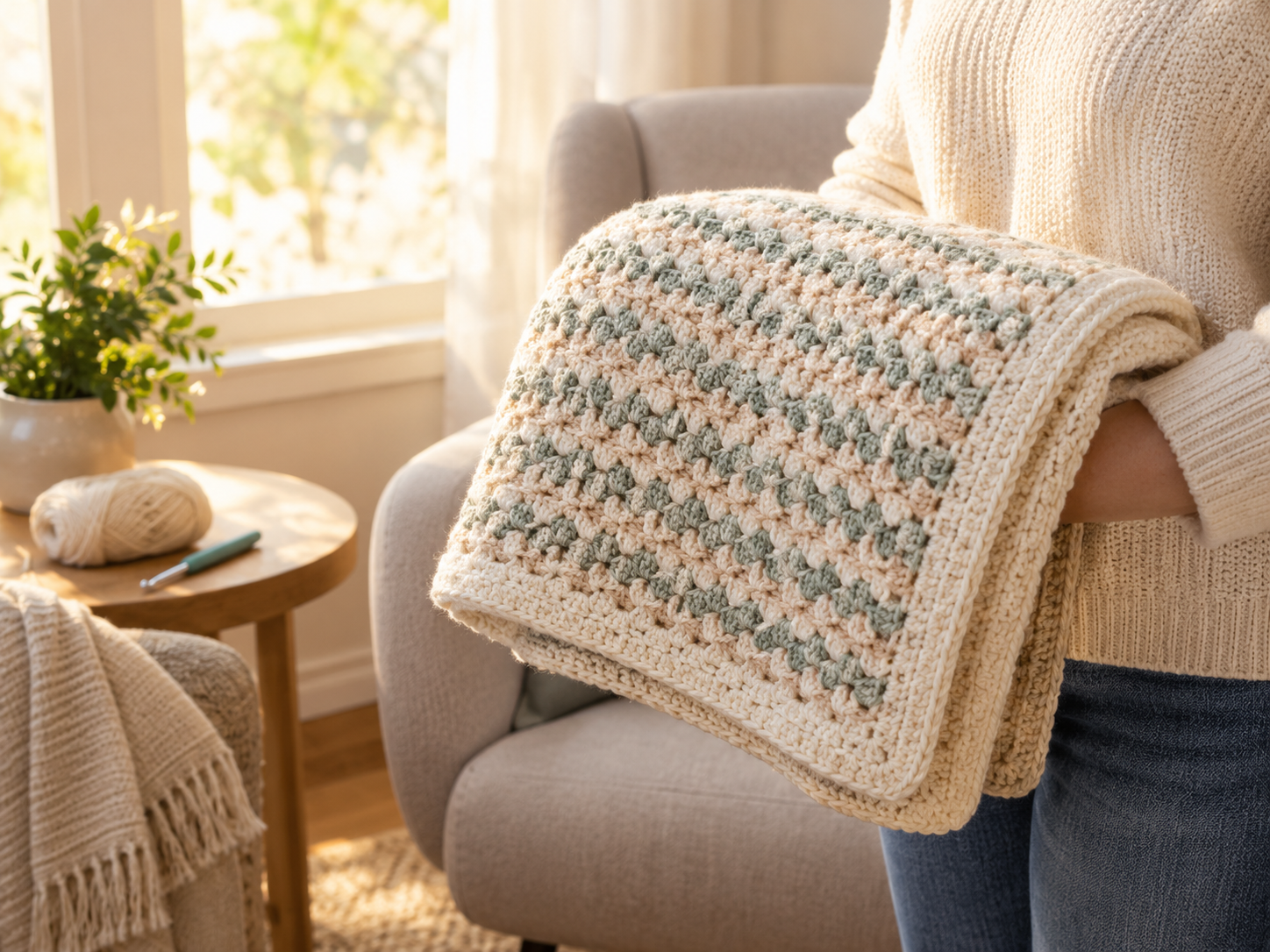
A crocheted blanket must not be placed in an infant’s sleep space, including a crib, bassinet, or play yard. The American Academy of Pediatrics advises keeping blankets and other loose bedding out of an infant’s sleep area because of risks that include suffocation, entrapment, and strangulation. See the AAP safe sleep guidance and the NIH Safe to Sleep environment recommendations. Yarn fiber or a handmade construction does not make loose bedding appropriate for unsupervised infant sleep.
A blanket may serve as a keepsake or be used during supervised awake time, with an attentive adult present. Follow the yarn label for laundering, wash the finished blanket before first use, and inspect it after washing. Check joins, corners, woven in ends, and pulled loops. Avoid fringe, ribbons, ties, buttons, detachable decorations, and loose shedding novelty fibers. If you are preparing a gift, the site’s guide to safe ways to use baby blankets offers additional reminders. Stop using the item if it develops holes, loose fibers, or insecure edges.
Search Demand and Publishing Timing
Available 2026 proxy data shows broader searches for “crochet blanket” at 74,000 in January and 40,500 in June and July. Those figures are not search volume for the exact phrase “crochet newborn blanket patterns.” Related crochet searches also show stronger interest in January, suggesting that winter and gift season can be useful publishing and promotion windows. Do not turn that proxy into an unsupported claim about exact keyword demand.
The article’s reason to exist is the family blanket and the practical process of examining, swatching, and planning a safer, clearly sized project. Invite readers to share a swatch or photograph if they choose, while making clear that a similar texture is not proof of the same stitch.
Conclusion
A family afghan can give you a valuable starting point, but identification takes more than a stitch name or a single photograph. Count a full repeat, compare both sides, work several repeats, and write down your own turning chain rule and row counts. Plan the size and yardage from a measured swatch, then explain what is estimated and what has actually been tested.
Keep infant sleep safety explicit and inspect the finished fabric and edges before gifting. If you are exploring crochet newborn blanket patterns to honor a loved one, start with a photograph or swatch today, record what you can verify, and share your questions or sample with the crochet community.
Frequently Asked Questions
Can I identify my grandmother’s afghan stitch from a photograph?
Sometimes, if the image clearly shows several repeats and both sides. Lighting, yarn texture, repairs, and borders can hide important details. Treat a visual match as a likely pattern family unless you can confirm it with an original pattern or actual swatch.
What does 19n + 18 mean in a crochet pattern?
It means the starting chain is 19 multiplied by the number of repeats, then 18 added. For five repeats, 19 × 5 + 18 equals 113 chains. This formula applies to the vintage pattern family described here, not all afghans.
How large should a newborn crochet blanket be?
Approximate planning options are 30 × 36 inches or 30 × 40 inches. Those are not tested dimensions for every stitch. Measure your gauge and check the finished dimensions because yarn, tension, stitch density, and borders change the result.
How much yarn should I buy?
A broad estimate is 900 to 1,400 yards for these size options, with another 10 to 15 percent allowance for borders and variation. Calculate a better estimate from the yarn used in your measured swatch and the target blanket area.
Can a crocheted newborn blanket go in a crib or bassinet?
No. Keep crocheted blankets and all other loose bedding out of infant sleep spaces, including cribs, bassinets, and play yards. Consider supervised awake time or a keepsake use instead.
{"@context":"https://schema.org","@type":"FAQPage","mainEntity":[{"@type":"Question","name":"Can I identify my grandmother’s afghan stitch from a photograph?","acceptedAnswer":{"@type":"Answer","text":"Sometimes, if the image clearly shows several repeats and both sides. Lighting, yarn texture, repairs, and borders can hide important details. Treat a visual match as a likely pattern family unless you can confirm it with an original pattern or actual swatch."}},{"@type":"Question","name":"What does 19n + 18 mean in a crochet pattern?","acceptedAnswer":{"@type":"Answer","text":"It means the starting chain is 19 multiplied by the number of repeats, then 18 added. For five repeats, 19 × 5 + 18 equals 113 chains. This formula applies to the vintage pattern family described here, not all afghans."}},{"@type":"Question","name":"How large should a newborn crochet blanket be?","acceptedAnswer":{"@type":"Answer","text":"Approximate planning options are 30 × 36 inches or 30 × 40 inches. Those are not tested dimensions for every stitch. Measure your gauge and check the finished dimensions because yarn, tension, stitch density, and borders change the result."}},{"@type":"Question","name":"How much yarn should I buy?","acceptedAnswer":{"@type":"Answer","text":"A broad estimate is 900 to 1,400 yards for these size options, with another 10 to 15 percent allowance for borders and variation. Calculate a better estimate from the yarn used in your measured swatch and the target blanket area."}},{"@type":"Question","name":"Can a crocheted newborn blanket go in a crib or bassinet?","acceptedAnswer":{"@type":"Answer","text":"No. Keep crocheted blankets and all other loose bedding out of infant sleep spaces, including cribs, bassinets, and play yards. Consider supervised awake time or a keepsake use instead."}}]}
Leave a Reply