




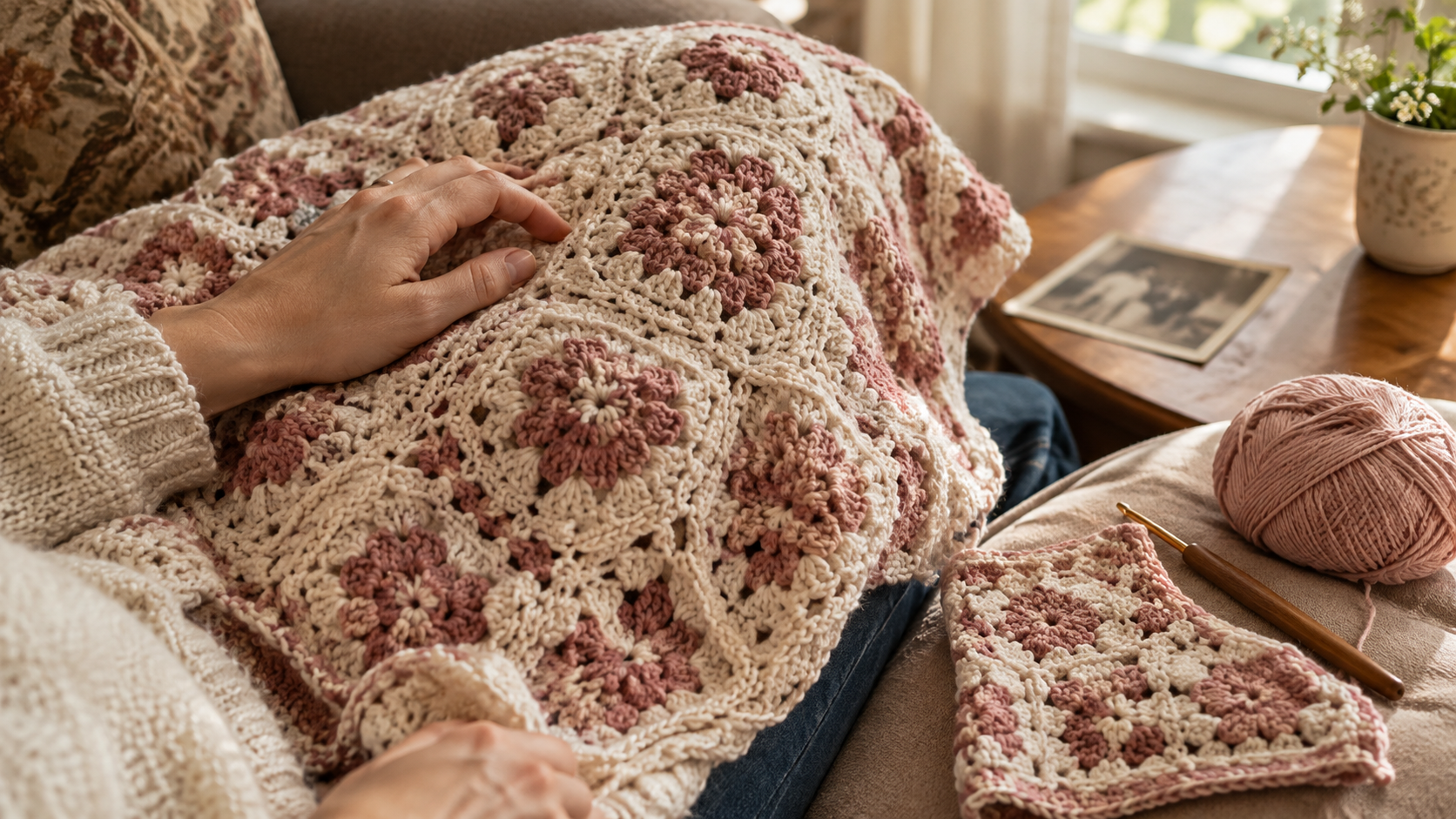


{“content_brief”:{“angle”:”Give floral baby blanket makers a practical test-and-adjust method for a flat border instead of relying on ‘work evenly,’ while treating color as personal design rather than a gender rule.”,”target_audience_persona”:”A crocheter who has finished or nearly finished a floral baby blanket and wants a complementary border color and a reliably flat edge. They may have a pattern that says one hdc per row but need to adapt that guidance to their own stitch, yarn, hook, gauge, tension, and edge construction. They want specific ways to prevent or fix pulling, cupping, rippling, and uneven placement without prescriptive color stereotypes.”,”outline”:[{“h2″:”Choose a Border Color That Supports the Flowers”,”key_concept”:”Explain how contrast, warm or cool undertones, saturation, value, and border width influence the finished look. Have readers compare yarn samples against the blanket in natural light and use photos or grayscale to assess visual weight. Offer cream, sage, blue-gray, lavender, earthy shades, and deeper neutrals; make clear pink is one option, not a requirement.”,”keywords”:[“baby blanket crochet pattern”],”data_stat”:”Research finding: a wide, dark border carries more visual weight than a narrow, pale one. There is no universal best border color or gender-based color rule.”},{“h2″:”Why ‘One HDC Per Row’ Is a Starting Point, Not a Universal Rule”,”key_concept”:”Show why row-ends and border stitches are not automatically equivalent. Explain how blanket stitch height, border-stitch width, yarn weight, hook size, maker’s gauge and tension, turning chains, and irregular edges change the required spacing. Treat one stitch per row-end as a testable starting point rather than a fixed formula.”,”keywords”:[“baby blanket crochet pattern”],”data_stat”:”Research finding: for an hdc blanket, one stitch per row-end is a common starting point; a geometry-based alternative is about 3 border stitches for every 2 hdc row-ends.”},{“h2″:”Measure Your Gauge Before Planning the Border”,”key_concept”:”Demonstrate how to use the actual blanket and proposed border fabric. Define stitches per inch and rows per inch, mark a 4-inch edge section, work the intended border stitch with its intended hook, count the stitches needed for a flat result, and calculate stitches per inch. Emphasize that the border yarn and hook belong in the test, especially if they differ from the blanket materials.”,”keywords”:[“baby blanket crochet pattern”],”data_stat”:”Research examples: a worsted-gauge reference gives roughly 3–4 sc stitches per inch. A separate hdc example is 14 stitches and 10 rows over 4 inches. These are examples, not universal gauge targets.”},{“h2″:”Test the Row-Edge Spacing on a Short Section”,”key_concept”:”Instruct readers to test their intended stitch and hook along a short stretch, then lay the blanket flat without stretching. Mark regular intervals and distribute any extra or skipped stitches to avoid visible steps and puckers. Continue long enough to see whether errors accumulate; the goal is an edge that follows the fabric without compressing or expanding it.”,”keywords”:[“baby blanket crochet pattern”],”data_stat”:”Research recommendation: test approximately 10–20 row-ends before committing to the full border, then continue for several inches or part of a round to catch accumulating errors.”},{“h2″:”Read the Edge: Pulling and Cupping Versus Rippling and Ruffling”,”key_concept”:”Provide a visual diagnosis. Pulling or cupping usually means too few stitches, tight tension, or a border stitch that is too narrow. Waves, ruffles, or flaring usually mean too many stitches, loose tension, or excessive corner increases. Check side edges separately from corners and lay the work flat as the border progresses.”,”keywords”:[“baby blanket crochet pattern”],”data_stat”:”Research finding: spacing errors can accumulate and may become visible only after several inches or rounds. Blocking cannot reliably correct a substantially incorrect stitch count.”},{“h2″:”Adjust the Count Without Creating a New Uneven Edge”,”key_concept”:”For a pulling edge, add stitches gradually at regular intervals. For rippling, skip row-ends periodically or redo an overfull foundation round. Mark intervals and distribute corrections rather than clustering them. Keep side spacing adjustments distinct from corner increases; redo the structurally wrong first round instead of trying to force later rounds flat.”,”keywords”:[“baby blanket crochet pattern”],”data_stat”:”Research examples: test an hdc edge at 3 stitches per 2 row-ends; for taller dc edges, suggested starting ratios include approximately 2 stitches per 3 rows or 3 per 4 rows. Present all ratios as experiments to test, not fixed rules.”},{“h2″:”Match the Border Stitch, Yarn, and Hook to the Blanket”,”key_concept”:”Explain that simple sc or hdc rounds are easier to control, while shells, fans, and other decorative stitches need spacing that fits their repeat. Cover how yarn weight, fiber, hook size, and tension change stitch dimensions and whether the border looks heavy, loose, or tight. Recommend a stabilizing round before decorative edging when useful.”,”keywords”:[“baby blanket crochet pattern”],”data_stat”:”Research finding: one published example has 14 hdc stitches and 10 rows over 4 inches, or about 3.5 stitches and 2.5 rows per inch. Use it to illustrate why the maker’s gauge matters more than an assumed row height.”},{“h2″:”Check the Border Color and Flatness After Washing”,”key_concept”:”Describe how fiber differences and care may alter dimensions, stitch definition, sheen, and color. Recommend making and washing a sample with the intended blanket yarn, border yarn, hook, and stitch; check for shrinkage, dye transfer, and pilling before committing. Follow the care needs of the most sensitive fiber in the project.”,”keywords”:[“baby blanket crochet pattern”],”data_stat”:”Research finding: a yarn-care test should check shrinkage, dye bleed against white fabric, and pilling after washing with the intended care method.”},{“h2″:”Quick Troubleshooting Checklist Before You Finish”,”key_concept”:”Close with a usable checklist: lay the blanket flat; identify pulling or waves; inspect corners independently; verify consistent row-edge placement; and redo the foundation round if the distortion is structural. Reinforce the central principle: judge the actual fabric, make gradual adjustments, and choose color by personal preference.”,”keywords”:[“baby blanket crochet pattern”],”data_stat”:”Research finding: a flat border depends on correct stitch count and tension. Blocking may reshape fabric temporarily, but it is not a dependable remedy for a substantially incorrect count.”}]}}
Crochet Baby Blankets
October 19, 2026
By Admin
6 min read
Baby Blanket Crochet Pattern: 7 Amazing Flat Border Guide

A
Written & Curated by
Admin — Crochters Editorial
Modern crochet tutorials, pattern guides & mindful craft wisdom.
Previous Article
crochet newborn blanket patterns: 7 Amazing Heirloom Guide
Next Article
Leave a Reply