


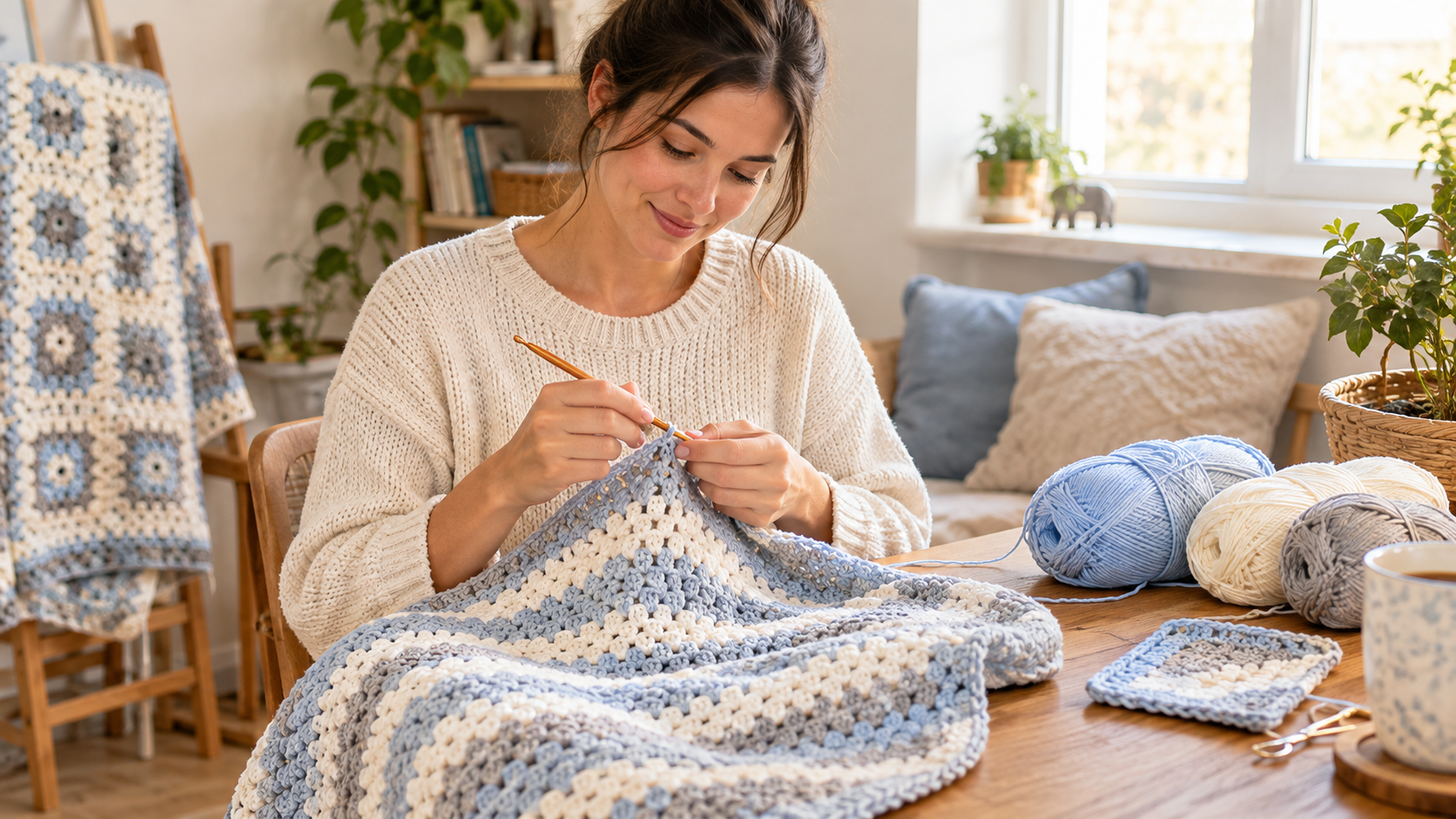



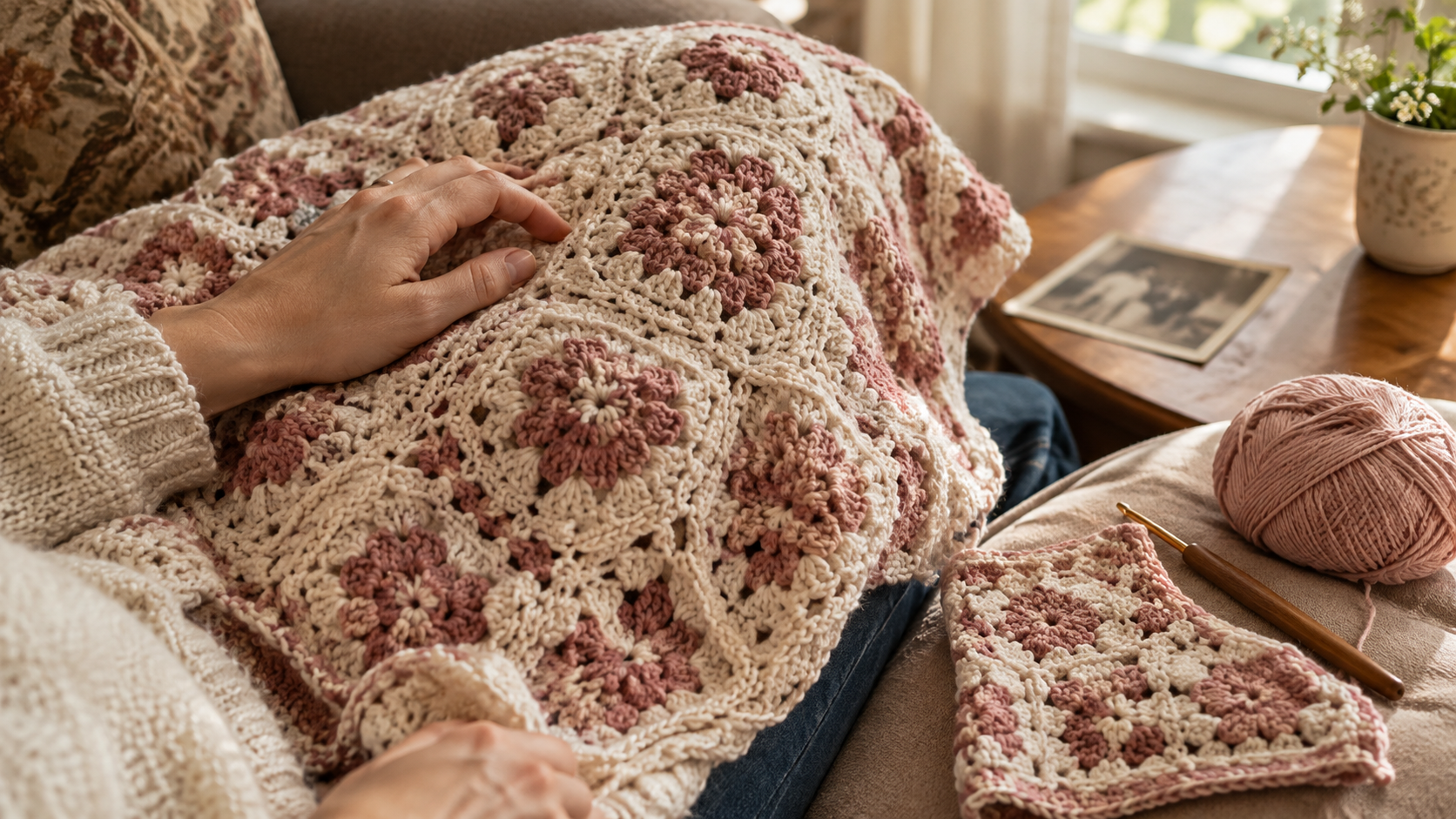


crochet baby blanket projects can look simple in a finished photo, but choosing the right pattern, estimating yarn, and keeping rows even all affect whether the gift turns out as planned. This guide gives you a practical way to verify a pattern and budget the work before you buy materials. One important limit: the supplied research does not identify a specific blanket, designer, pattern page, or verified project materials, so no particular design below is presented as the featured pattern.
Key Takeaways
- Confirm the designer, source pattern, finished size, gauge, and yarn requirements before treating any instructions as project specific.
- Swatch with your intended yarn and hook, track row counts, and reserve enough yarn for the border and finishing.
- General time and trend figures are comparisons only. They do not predict this unverified project or exact phrase search volume.
- The core concept and project checks
- Step by step planning guide
- Advanced analysis and common pitfalls
- Conclusion
- Frequently asked questions
The Core Concept: Plan a Crochet Baby Blanket You Can Finish
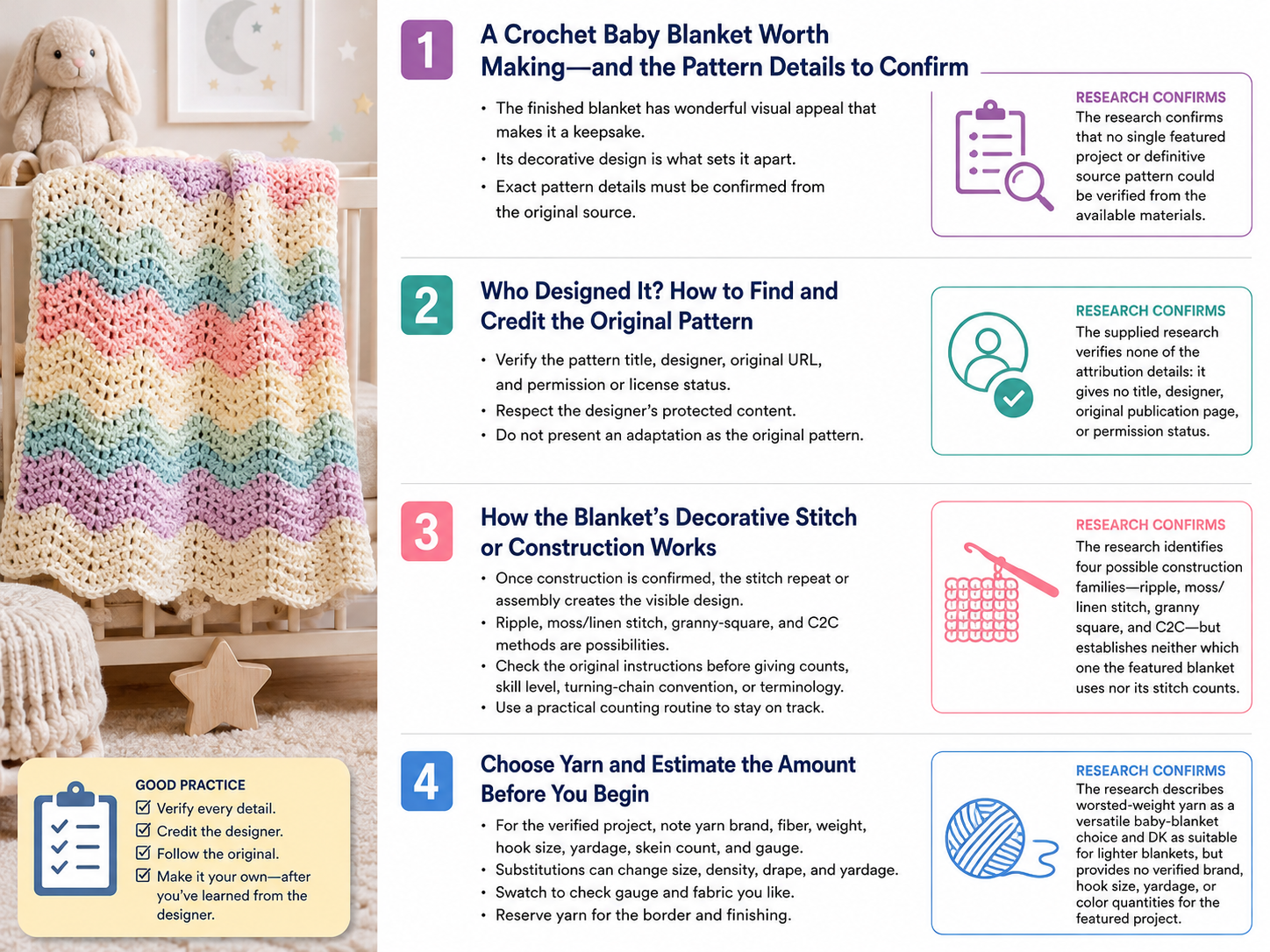
A handmade blanket is appealing because it can be chosen for a particular family, color palette, and occasion. The stitch texture, stripes, squares, or shaped edges can make a finished piece distinctive. But a photograph alone cannot tell you its pattern name, construction, yarn, hook, or measurements. The available research confirms that no single featured project or definitive source pattern could be verified. Treat any design details as unknown until you locate the original pattern and check them.

Find and credit the original pattern
Before beginning, record the pattern title, designer name, original publication page, publication or revision date, and license or permission terms. If the blanket came from a social post or an image search, trace it to the designer’s own page rather than relying on a repost. If you cannot verify the source, say so. Do not invent a title or imply that a generic stitch tutorial reproduces the pictured blanket.
Standard stitch names and abbreviations are technical terms. A designer’s specific written instructions, chart, photographs, and complete row sequence are different. Do not copy those materials without authorization. If you make your own version, identify it as an adaptation and explain the changes. For more about reading pattern structure, see our guide to crochet sweater patterns; the same habit of checking gauge, skill level, and materials helps with blankets.
Confirm what creates the visible design
The research mentions four possible construction families: ripple, moss or linen stitch, granny square, and corner to corner, often called C2C. It does not confirm which one a featured blanket uses, nor does it provide that project’s stitch count. A ripple typically uses increases and decreases to make peaks and valleys. Moss stitch alternates single crochet and chain spaces for a woven look. Granny squares build in rounds and are joined or worked continuously. C2C grows diagonally in blocks, with increases followed by decreases.
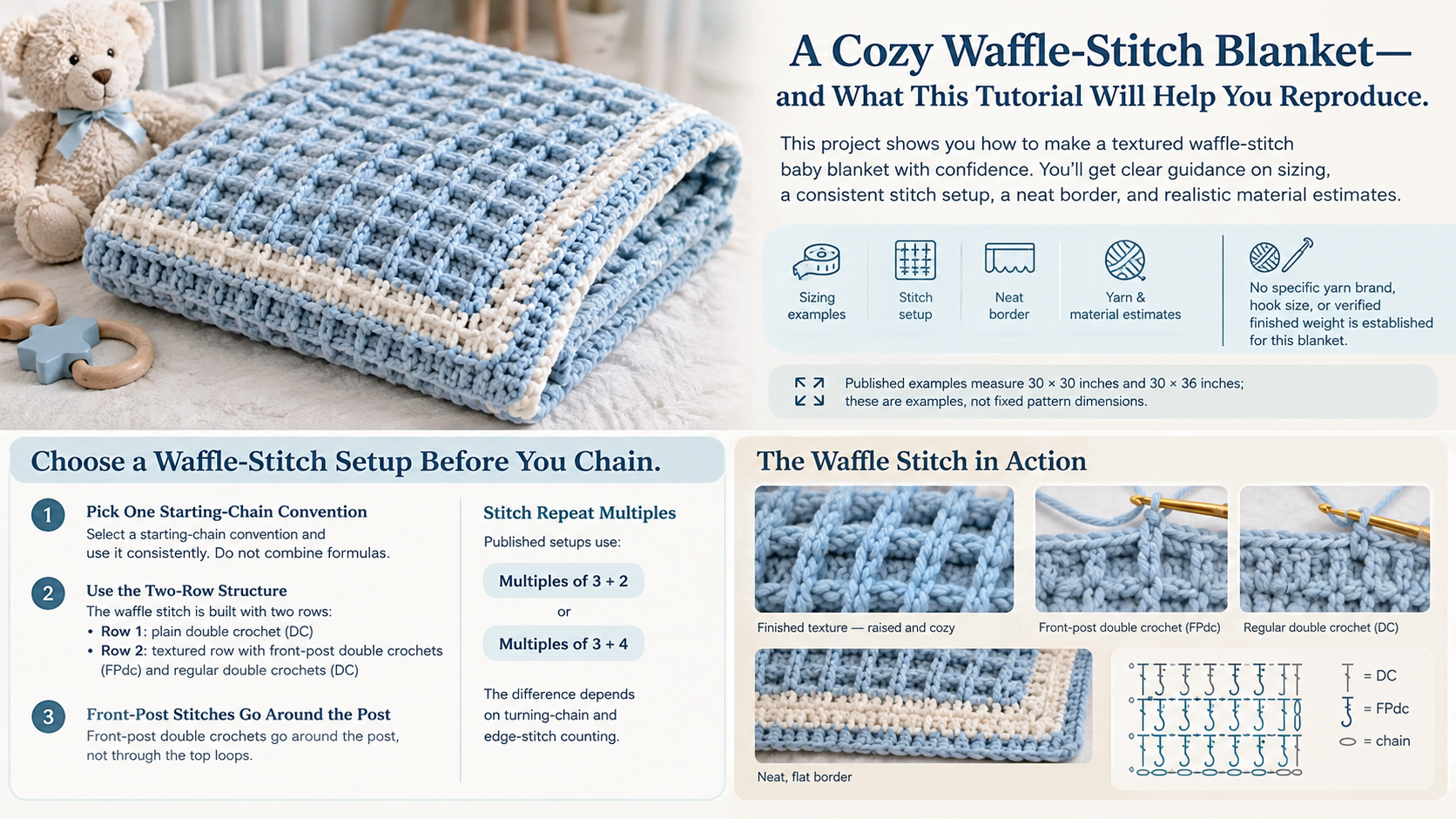
These are useful ways to recognize a technique, not instructions for a particular blanket. Before starting, check whether the pattern uses US or UK terms, whether its turning chain counts as a stitch, how many stitches make one repeat, and what count you should have at each row end. Never infer an exact repeat from a photograph.
Step by Step: Check Materials, Time, and Construction
Use this planning sequence before committing to a large project. It can prevent the common problem of discovering halfway through that your substitute yarn, dimensions, or schedule do not match your plans.
1. Check the pattern specification
Look for skill level, finished dimensions, materials, gauge, abbreviations, construction notes, and complete color instructions. A trustworthy pattern should state the hook size and yarn weight, along with total yardage and, for a multicolor project, the amount needed for each color. Check whether border yarn is included in the total. If details are missing, contact the designer or choose a pattern with enough information to plan accurately.
2. Choose yarn by fabric and care needs
Worsted weight is a versatile general choice for blankets, while DK can make a lighter fabric and support finer stitch detail. Acrylic and cotton blends are commonly used for softness, washability, and durability. Fiber alone does not guarantee that a yarn suits a pattern: a different brand with the same weight label can produce a different gauge. Check the care label and make sure the recipient can wash the finished item as intended.
Changing yarn weight or hook size can alter dimensions, density, drape, and yardage. Cotton may feel less elastic and can make a blanket heavier. Chenille is plush, but its texture can hide stitches and make counting more difficult. Review our yarn buying guide when comparing fiber, labels, and substitutions. Do not purchase based only on the number of skeins shown in a different project.
3. Estimate the amount and cost honestly
Use the verified pattern’s yardage, then calculate skeins from the usable yardage printed on each label. Keep colors and dye lots consistent where possible. Add a practical reserve for your swatch, gauge differences, joins, and border, rather than assuming the final few yards will be enough. Set aside the border yarn before you begin the body so it cannot be used accidentally in the last rows.
Make a budget that includes main and contrast yarn, hook, tapestry needle, stitch markers, scissors, blocking supplies if needed, and gift packaging. The research supplies no project specific prices, so a precise total would be misleading. Our guide to evaluating a baby blanket crochet pattern can help you decide whether to continue, adapt, or restart after a test swatch.
4. Plan the hours and gift date
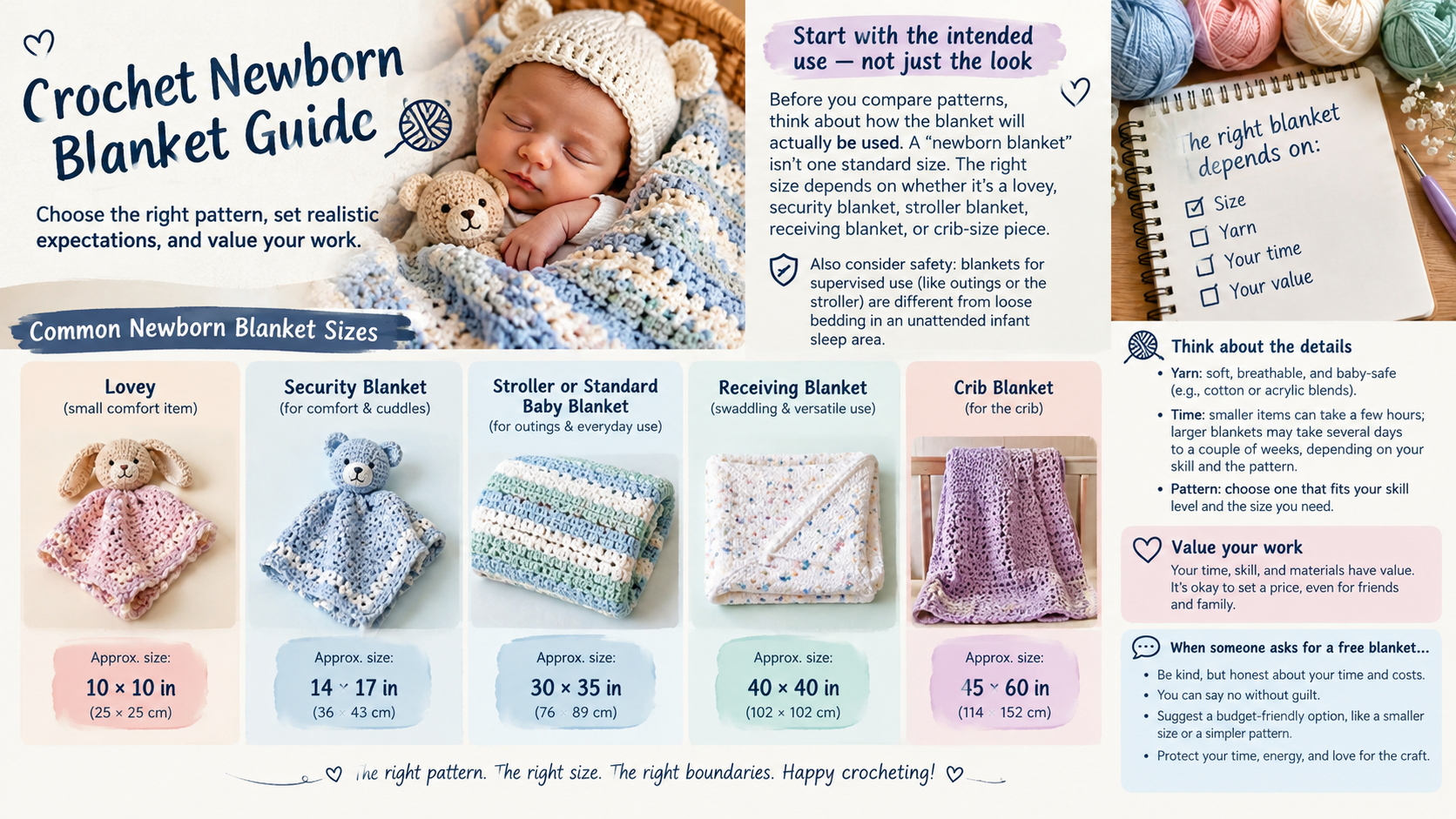
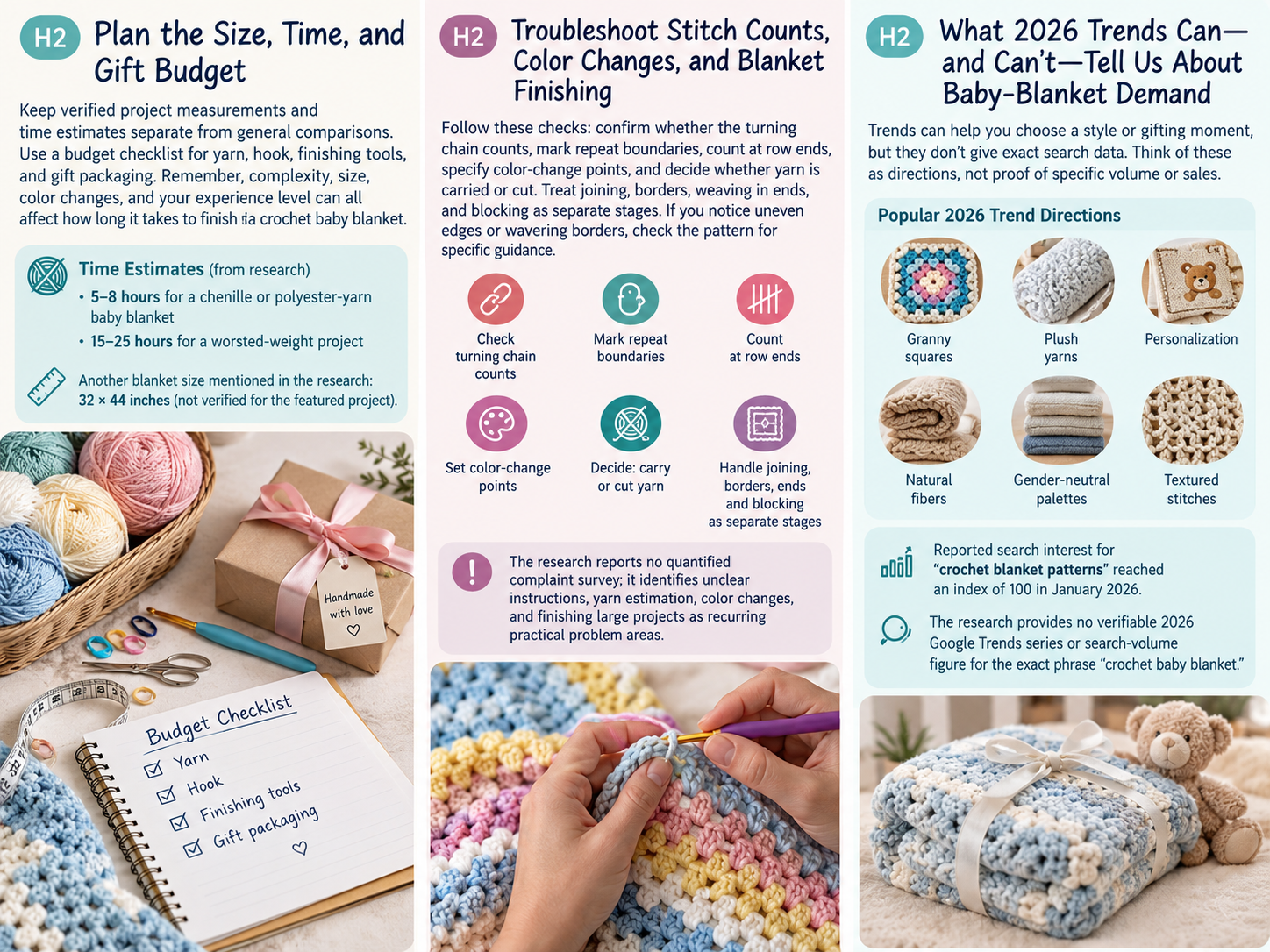
Available research gives broad comparisons of about 5 to 8 hours for a chenille or polyester yarn blanket and 15 to 25 hours for a worsted weight project. These figures are not estimates for the unidentified blanket. Your actual time depends on dimensions, stitch complexity, color changes, border work, experience, and corrections. One cited project measured about 32 by 44 inches, but that is also not a verified size for this project.
To make a personal estimate, crochet a measured swatch for a fixed period, calculate how much fabric you complete, and compare it with the pattern’s finished dimensions. Add separate time for joining, weaving in ends, blocking, and wrapping. Begin earlier than you think you need to, especially if the gift date is fixed.
Advanced Analysis and Common Pitfalls
Keep row counts from drifting
Confusion about turning chains, first stitch placement, and repeat boundaries can gradually distort a blanket. Read the pattern notes before starting and write down whether the turning chain counts. Mark the first and last actual stitch. At the end of each repeat, check the count; at the end of each row, compare your count with the pattern. Fix a discrepancy immediately instead of carrying it into later rows.
If the edge grows or shrinks, compare the current row with the last correct one. Check for a missed stitch at the beginning or end, an accidental stitch into a turning chain, or an increase or decrease placed in the wrong spot. For ripple work, verify every peak and valley rather than counting only the full row. For C2C, confirm the expected block count before continuing.
Make color changes explicit
Write down the row or stitch where each color begins and ends. Check whether the pattern changes color on the final yarn over of a stitch, cuts the old yarn, or carries it along an edge. Carrying yarn saves ends but can show through or pull the edge; cutting produces more ends to weave in. In modular blankets, check that each square’s colors and orientation match before joining.
Finish in separate stages
Do not treat finishing as one final chore. Complete joins, weave in ends securely, add the border, and block only if the fiber and pattern allow it. A border that waves may have too many stitches along the sides; a border that pulls may have too few. Test the spacing along one side and corner before working all the way around. For more focused troubleshooting, read our guide to a flat baby blanket border. Reserve time for a final inspection of loose ends, skipped stitches, and uneven joins.
| Choice or issue | What the research supports | What to verify for your project |
|---|---|---|
| Yarn | Worsted is versatile; DK suits a lighter blanket. | Fiber, brand, hook, gauge, total yardage, and yardage by color. |
| Time | Broad comparison: 5 to 8 hours for chenille or polyester, 15 to 25 hours for worsted. | Your pace, size, stitch, color changes, and finishing hours. |
| Size | A separate cited example is about 32 by 44 inches. | The actual pattern’s finished measurements and intended use. |
Use trends as inspiration, not proof of demand
Reported 2026 directions include granny squares, plush yarn, personalization, natural fibers, muted or gender neutral palettes, and textured stitches. The research reports that search interest for “crochet blanket patterns” reached an index of 100 in January 2026. It does not provide a verifiable Google Trends series or search volume for the exact phrase “crochet baby blanket.” Check Google Trends directly if you need to investigate a phrase, and do not treat the broader blanket figure as evidence of baby blanket search volume.
Choose a trend only if it suits the recipient and the practical use. Personalization adds labor; chenille may be harder to count; and a natural fiber may require more careful washing. For infant sleep guidance, review the US Consumer Product Safety Commission safe sleep information and the American Academy of Pediatrics safe sleep guidance. Handmade blankets should not be placed in an infant sleep space. Follow current safe sleep recommendations and use a blanket only in an appropriate supervised context. For more gift planning, see our crochet baby gift guide.
Conclusion
A successful blanket starts with a pattern you can identify and specifications you can verify. Check the designer and terms, swatch the chosen yarn, track stitch counts, budget for finishing, and keep estimates separate from confirmed project facts. No exact pattern, material list, or dimensions can be claimed from the supplied research.
Before you buy yarn, confirm the source pattern and make a swatch. Then use this checklist to plan your crochet baby blanket, and share your finished project only with accurate pattern credit and safe use in mind.
Frequently Asked Questions
Which crochet stitch is best for a baby blanket?
There is no single best stitch for every project. Moss stitch makes a flexible, woven looking fabric; granny squares are modular; ripple stitches create peaks and valleys. Choose according to the verified pattern, your experience, the yarn, and the care needs. Check stitch density and finishing before gifting.
How much yarn does a crochet baby blanket need?
The amount depends on the pattern, finished size, stitch, gauge, yarn weight, and colors. Use the original pattern’s yardage and skein information, then swatch with your chosen yarn. The supplied research does not verify yardage for a particular featured blanket.
How long does it take to crochet a baby blanket?
The research cites broad comparisons of about 5 to 8 hours for a chenille or polyester yarn blanket and 15 to 25 hours for a worsted weight project. These are not guarantees. Size, stitch complexity, experience, color changes, and finishing can change the time substantially.
How do I stop my blanket edges from becoming uneven?
Confirm whether the turning chain counts, mark the first and last actual stitches, and compare each row end count with the pattern. Check repeat boundaries as you work. For a rippling border, test whether side spacing is too generous; for a tight border, test whether it needs more stitches.
Can a crochet baby blanket be used in an infant crib?
Do not use a loose blanket in an infant sleep space. Follow current safe sleep guidance from your pediatrician and public health authorities. A handmade blanket may be appropriate for supervised use outside the sleep space, provided it is in good condition and used safely.
{"@context":"https://schema.org","@type":"FAQPage","mainEntity":[{"@type":"Question","name":"Which crochet stitch is best for a baby blanket?","acceptedAnswer":{"@type":"Answer","text":"There is no single best stitch for every project. Moss stitch makes a flexible, woven looking fabric; granny squares are modular; ripple stitches create peaks and valleys. Choose according to the verified pattern, your experience, the yarn, and the care needs. Check stitch density and finishing before gifting."}},{"@type":"Question","name":"How much yarn does a crochet baby blanket need?","acceptedAnswer":{"@type":"Answer","text":"The amount depends on the pattern, finished size, stitch, gauge, yarn weight, and colors. Use the original pattern’s yardage and skein information, then swatch with your chosen yarn. The supplied research does not verify yardage for a particular featured blanket."}},{"@type":"Question","name":"How long does it take to crochet a baby blanket?","acceptedAnswer":{"@type":"Answer","text":"The research cites broad comparisons of about 5 to 8 hours for a chenille or polyester yarn blanket and 15 to 25 hours for a worsted weight project. These are not guarantees. Size, stitch complexity, experience, color changes, and finishing can change the time substantially."}},{"@type":"Question","name":"How do I stop my blanket edges from becoming uneven?","acceptedAnswer":{"@type":"Answer","text":"Confirm whether the turning chain counts, mark the first and last actual stitches, and compare each row end count with the pattern. Check repeat boundaries as you work. For a rippling border, test whether side spacing is too generous; for a tight border, test whether it needs more stitches."}},{"@type":"Question","name":"Can a crochet baby blanket be used in an infant crib?","acceptedAnswer":{"@type":"Answer","text":"Do not use a loose blanket in an infant sleep space. Follow current safe sleep guidance from your pediatrician and public health authorities. A handmade blanket may be appropriate for supervised use outside the sleep space, provided it is in good condition and used safely."}}]}
Leave a Reply