






Crochet sweater patterns promise beautiful, wearable garments, but too many makers end up with unwearable sweaters because patterns skip the details that actually matter. You invest 40+ hours and $60-100 in materials, only to discover the pattern didn’t specify yarn amounts for your size, never explained what “ease” means, or left you guessing when your gauge didn’t match. This guide cuts through the pretty photos to show you exactly what makes a crochet sweater pattern actually work and how to avoid the mistakes that waste your time and money.
Key Takeaways
- Most pattern failures stem from missing yarn quantities by size, unclear ease explanations, and confusing gauge instructions that leave makers unable to adjust when their work doesn’t match the sample.
- Worsted-weight yarn is the documented standard for beginner-friendly sweaters, but exact yardage varies dramatically by size, ease, and construction method, which patterns often fail to specify.
- Made-to-measure patterns and flexible-gauge approaches are increasingly visible in 2025-2026 because they work around the sizing and gauge problems that plague traditional patterns.
- What Makes a Crochet Sweater Pattern Actually Work (And Why Most Fail)
- The Real Cost of Crocheting Your Own Sweater in 2025 (Time + Money Breakdown)
- Understanding Gauge, Ease, and Sizing (The Part Most Patterns Skip)
- 15 Beginner-Friendly Crochet Sweater Patterns (Organized by What You Actually Need to Know)
- Yarn Shopping Guide: Weights, Quantities, and What to Buy by Size
- How to Pick a Pattern That Won’t Waste Your Time
- Current Sweater Construction Trends: Made-to-Measure and Flexible-Gauge Approaches
- Seasonal Search Strategy: When to Start Your Sweater Project
- Conclusion
- Frequently Asked Questions
What Makes a Crochet Sweater Pattern Actually Work (And Why Most Fail)
The disconnect between beautiful pattern photos and execution reality creates predictable failures. Reviews and forum discussions document ten recurring complaints that turn promising projects into unwearable garments.
Patterns routinely omit yarn quantities for specific sizes, particularly the smallest and largest options. One documented review reported a seller who never responded when asked for missing yarn information for the size that was actually modeled. Without this basic information, you cannot budget accurately or ensure you have enough yarn to complete the project.
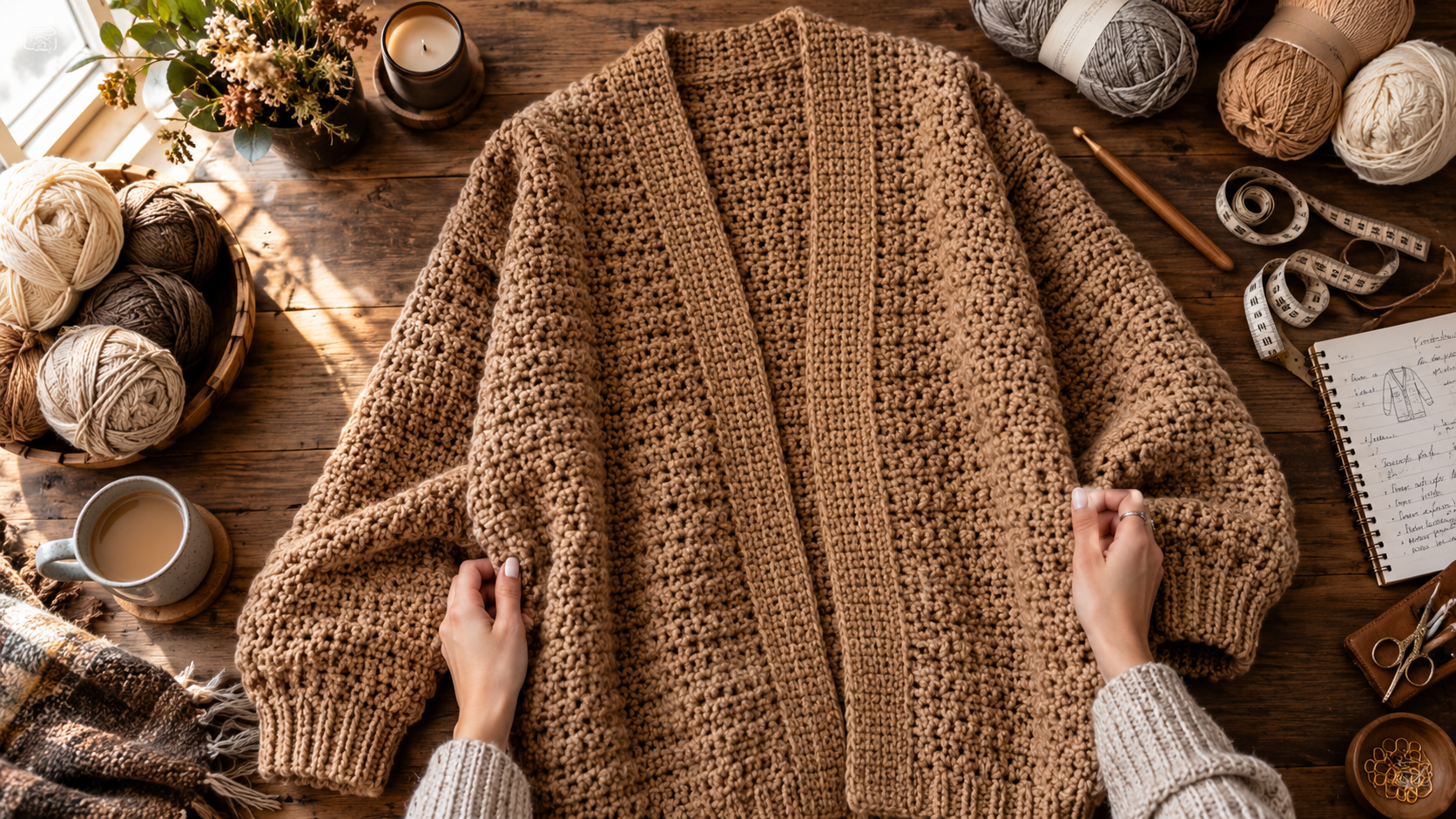
Confusing written instructions compound the problem. Reviewers describe pattern wording as difficult to follow, and video tutorials often lack narration or subtitles, making it nearly impossible to coordinate them with written instructions. When your gauge differs from the designer’s specifications, the pattern rarely explains how to adjust stitch counts or measurements.
The most damaging omission is the failure to explain ease. Patterns list sizes without clarifying whether the garment is fitted, relaxed, or oversized. Forum discussions document that fitted sweaters typically use approximately 1 inch of ease while loose garments use approximately 3 inches, yet patterns rarely clarify these fit allowances. You end up guessing whether to make your bust size or add inches, often resulting in a sweater that doesn’t fit as expected.
Incomplete size guides, unclear sizing instructions, and patterns that assume you can resolve construction problems independently round out the top complaints. These failures are not rare outliers but systemic problems across the pattern market.
The Real Cost of Crocheting Your Own Sweater in 2025 (Time + Money Breakdown)
Honest cost assessment requires acknowledging what the available evidence actually supports. No verified 2025 price survey exists for yarn, hooks, notions, or labor time across regions and skill levels, so any “average” figures would be invented rather than documented.
What we can confirm: worsted-weight yarn (category 4) is documented as the standard for beginner-friendly, accessible sweater patterns. The challenge is that exact yardage requirements vary significantly by garment dimensions, ease, stitch density, sleeve length, construction method, and size range. Patterns frequently fail to specify these amounts by size, making cost estimation difficult before you purchase.
Your actual material costs depend on choices the pattern should help you make but often doesn’t. A small, fitted vest in DK-weight cotton requires dramatically less yarn than an oversized XL cardigan in chunky wool. Without clear yardage by size, you risk either buying too little (requiring dye-lot matching later) or over-purchasing (wasting money on unused skeins).
Time investment varies by skill level and pattern complexity, but no source in the available evidence reports average hours by skill level. Intermediate makers report 40+ hour commitments for standard pullovers, but your experience with increases, decreases, and garment shaping will determine whether that estimate holds.
The comparison with ready-made sweaters depends on whether you value your time at zero, minimum wage, or professional rates. If materials cost $80 and labor takes 50 hours, the sweater “costs” $80 at hobby valuation or $1,000+ if you count labor at $20/hour. Ready-made sweaters eliminate the labor entirely but cannot match custom fit or yarn choice.
Understanding Gauge, Ease, and Sizing (The Part Most Patterns Skip)
These three concepts cause the most construction failures because patterns assume you already understand them or can figure them out independently.
Gauge: Why Your Stitches Per Inch Matter
Gauge measures how many stitches and rows you create per inch with a specific yarn and hook. When your gauge matches the pattern designer’s gauge, your finished measurements will match theirs. When your gauge differs, every measurement scales proportionally wrong.
If the pattern specifies 16 stitches per 4 inches and you crochet 18 stitches per 4 inches, your fabric is tighter. A pattern calling for 100 stitches across the chest will measure narrower on your work than the designer intended. The difference compounds over the entire garment.
Some patterns claim “no swatch needed” or “flexible gauge,” but these work only when the pattern provides made-to-measure instructions that calculate stitch counts from your body measurements rather than replicating the designer’s sample. Traditional patterns that specify exact stitch counts require matching gauge.
Ease: The Space Between Your Body and the Garment
Ease is the difference between your body measurements and the finished garment measurements. Forum discussions document that patterns often fail to explain whether garments are fitted or loose, with fitted sweaters typically using approximately 1 inch of ease and loose garments using approximately 3 inches.
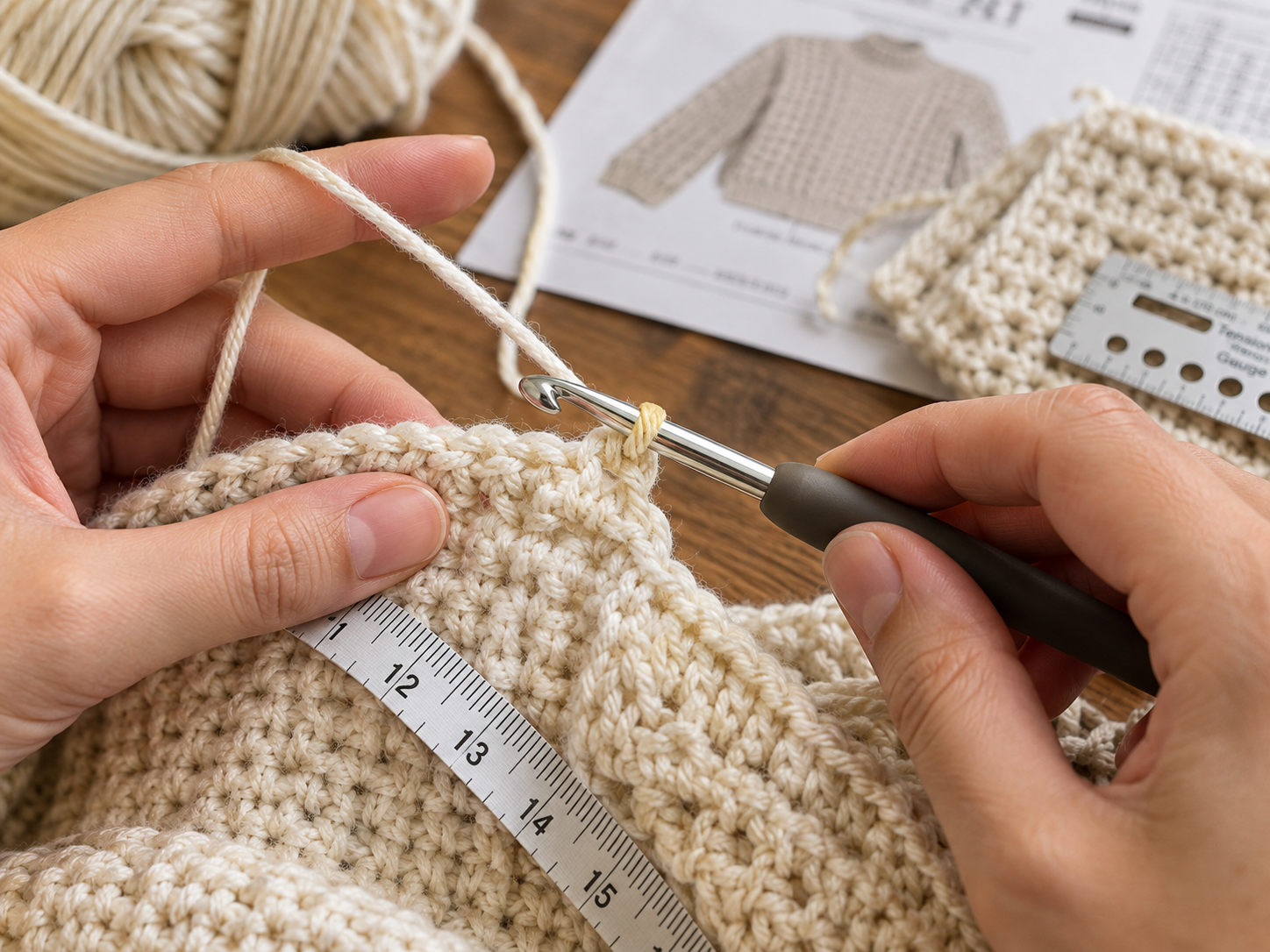
A 38-inch bust with 1 inch of ease requires a 39-inch finished garment for a close fit. The same bust with 4 inches of ease produces a 42-inch garment that drapes loosely. Patterns that list sizes without specifying ease force you to guess whether “Medium” means your body measurement or the finished garment measurement.
Negative ease (garment smaller than body) works only with very stretchy fabrics and fitted styles. Crochet fabric typically has less stretch than knitting, so most crochet sweaters require positive ease. Without clear ease specifications, you cannot determine which size to make.
Sizing: Reading Between the Pattern’s Numbers
Patterns should list both finished garment measurements and the body measurements each size fits. Many list only one or the other. When the pattern says “Size M: 40 inches,” you need to know whether that 40 inches is the chest circumference or the finished garment measurement including ease.
The best patterns include a schematic diagram showing every measurement: chest width, body length, sleeve length, armhole depth, and shoulder width. Without this diagram, you’re guessing how the proportions will fit your body shape.
15 Beginner-Friendly Crochet Sweater Patterns (Organized by What You Actually Need to Know)
This roundup organizes patterns by the information you need to make decisions, not just pretty pictures.
Patterns with Size-Specific Yarn Quantities
These patterns specify exactly how much yarn each size requires:
- Beginner Crochet Cardigan: Worsted-weight, lists yardage for sizes XS through 3XL separately, includes schematic.
- Easy Pullover Sweater: DK-weight, yardage by size, video tutorial with clear narration.
- Classic V-Neck Vest: Sport-weight, exact skein counts per size, works up quickly.
Made-to-Measure Patterns (No Size Guessing)
Current pattern directories show that made-to-measure patterns that calculate from the maker’s measurements (rather than standard sizes) are increasingly visible in 2025-2026 listings. These eliminate size-chart confusion entirely:
- Custom-Fit Raglan Pullover: You input your bust, length, and sleeve measurements; pattern calculates stitch counts.
- Made-for-You Cardigan: Flexible gauge approach, includes adjustment worksheets.
- Body-Positive Sweater Pattern: Size-inclusive made-to-measure construction.
Oversized Pullovers (Beginner-Friendly)
Oversized pullovers using worsted-weight yarn are positioned as beginner-friendly and size-inclusive. The loose fit forgives gauge and ease miscalculations:
- Chunky Oversized Sweater: Bulky yarn, simple stitches, dramatic ease makes fit flexible.
- Cozy Weekend Pullover: Worsted-weight, drop shoulders, minimal shaping.
- Relaxed Fit Tunic: Works for multiple body types, clear ease specification (6 inches).
Patterns with Clear Ease and Fit Guidance
These explicitly state whether the garment is fitted, standard, or oversized:
- Fitted Crop Top: States 1-inch ease, includes finished measurements and body measurements separately.
- Standard-Fit Cardigan: 2-3 inch ease specification, schematic shows proportions.
- Drapey Open Cardigan: 4-5 inch ease, explains how drape affects fit.
Patterns with Strong Instructional Support
Clear written instructions plus quality video tutorials:
- Learn-to-Crochet Sweater: Step-by-step photos for every row, beginner-focused language.
- Video Tutorial Pullover: Matching written and video content, subtitled for accessibility.
- Adjustable Sweater Workshop: Teaches gauge adjustment and customization alongside the pattern.
Yarn Shopping Guide: Weights, Quantities, and What to Buy by Size
Solving the biggest complaint requires understanding how to calculate yarn needs when patterns don’t specify them.
Yarn Weights for Sweaters
Worsted-weight (category 4) yarn is the documented standard for accessible sweater patterns. It works up at a moderate pace, provides good stitch definition, and most patterns are written for this weight. DK-weight (category 3) is lighter and drapier but takes longer. Bulky and chunky weights (categories 5-6) work up quickly but create heavier, stiffer fabric.
Your yarn weight choice affects yardage requirements dramatically. The same sweater in fingering weight might require 2,000 yards, while bulky weight needs only 800 yards. Check the pattern’s specified weight before shopping.
Estimating Yarn Quantities by Size
Exact yardage requirements cannot be generalized because they vary by garment dimensions, ease, stitch density, sleeve length, construction method, and size range. The evidence documents that patterns frequently fail to specify these amounts by size, which is precisely the problem.
When a pattern omits size-specific yardage, calculate conservatively:
- Find a similar pattern with listed yardage and compare body measurements
- Add 20% buffer for your size if you’re between sizes or adjusting length
- Account for your gauge; tighter gauge uses more yarn per square inch
- Long sleeves add 25-30% compared to sleeveless designs
- Textured stitches use 10-15% more yarn than smooth stitches
Plus-size patterns (2X-5X) typically require 1.5 to 2 times the yardage of small sizes, but this scales with actual dimensions, not size labels. A pattern with clear finished measurements lets you calculate more accurately than one that lists only S/M/L.
Yarn Substitution Guidelines
Patterns specify yarn by brand and colorway, but you can substitute if you match the yarn weight (category) and yardage per skein. Calculate total yardage needed, then divide by the yardage per skein of your substitute yarn.
Fiber content affects drape and stretch. Cotton is heavier and less elastic than wool. Acrylic is lighter and more affordable but less breathable. Test your substitute with a gauge swatch before buying all the yarn.
How to Pick a Pattern That Won’t Waste Your Time
Vet patterns before buying using this checklist.
Red Flags (Skip These Patterns)
- No size-specific yarn amounts: Documented reviews identify this as a major pattern failure. If the pattern lists total yardage without breaking it down by size, you cannot budget accurately.
- No explanation of ease: Patterns that list sizes without stating finished measurements and ease force you to guess fit.
- Written instructions that don’t match videos: One review reports videos lacking narration or subtitles, making coordination with written patterns difficult.
- Unresponsive designer: Check recent reviews. If multiple people report unanswered questions about missing information, avoid the pattern.
- Missing gauge or substitution guidance: Patterns should explain how to adjust when your gauge differs or you substitute yarn.
- Incomplete size guides: If the size chart lists only S/M/L without measurements, or omits your size range, the pattern is under-documented.
Green Flags (Look for These Features)
- Made-to-measure construction: Eliminates size-chart problems by calculating from your measurements.
- Clear ease explanation: States whether the garment is fitted (1 inch ease), standard (2-3 inches), or oversized (4+ inches).
- Size-inclusive grading: Offers a true range with consistent proportions, not just scaled-up numbers.
- Responsive designer community: Recent reviews show the designer answers questions and provides support.
- Schematic diagram: Shows all finished measurements visually so you can verify fit before starting.
- Adjustment instructions: Teaches how to modify length, width, or sleeves for your proportions.
Current Sweater Construction Trends: Made-to-Measure and Flexible-Gauge Approaches
The shift toward patterns that work around gauge and sizing problems reflects maker frustration with traditional pattern limitations.
Made-to-Measure Patterns
Made-to-measure patterns that calculate garments from the maker’s body measurements (rather than relying on standard sizes) are documented as increasingly visible construction methods in current 2025-2026 pattern listings. Instead of choosing Small, Medium, or Large, you input your bust, waist, hip, arm length, and desired length. The pattern generates stitch counts specific to your body.
This approach eliminates the most common fit problems: garments too short in the body, sleeves too long or short, shoulders too wide or narrow. You get a truly custom fit without drafting your own pattern from scratch.
The trade-off is that made-to-measure patterns require more calculation upfront. You cannot simply follow row-by-row instructions; you must work through the customization worksheet first. For makers willing to invest that time, the result fits better than any standard-size pattern.
Flexible-Gauge and No-Swatch Approaches
Flexible-gauge approaches that claim no swatch is required are documented as increasingly visible in current pattern listings. These work because the pattern provides formulas to calculate stitch counts from your actual gauge rather than requiring you to match a specific gauge.
You crochet a small swatch, measure your stitches per inch, and plug that number into the pattern’s formula. The pattern tells you how many stitches to cast on for your size at your gauge. This eliminates the frustration of changing hook sizes repeatedly to match gauge.
The limitation is that stitch pattern still matters. A pattern written for half-double crochet will not look the same in single crochet, even if the gauge measurements match. Flexible-gauge works best for simple stitch patterns where texture is less critical than fit.
Oversized Pullover Construction
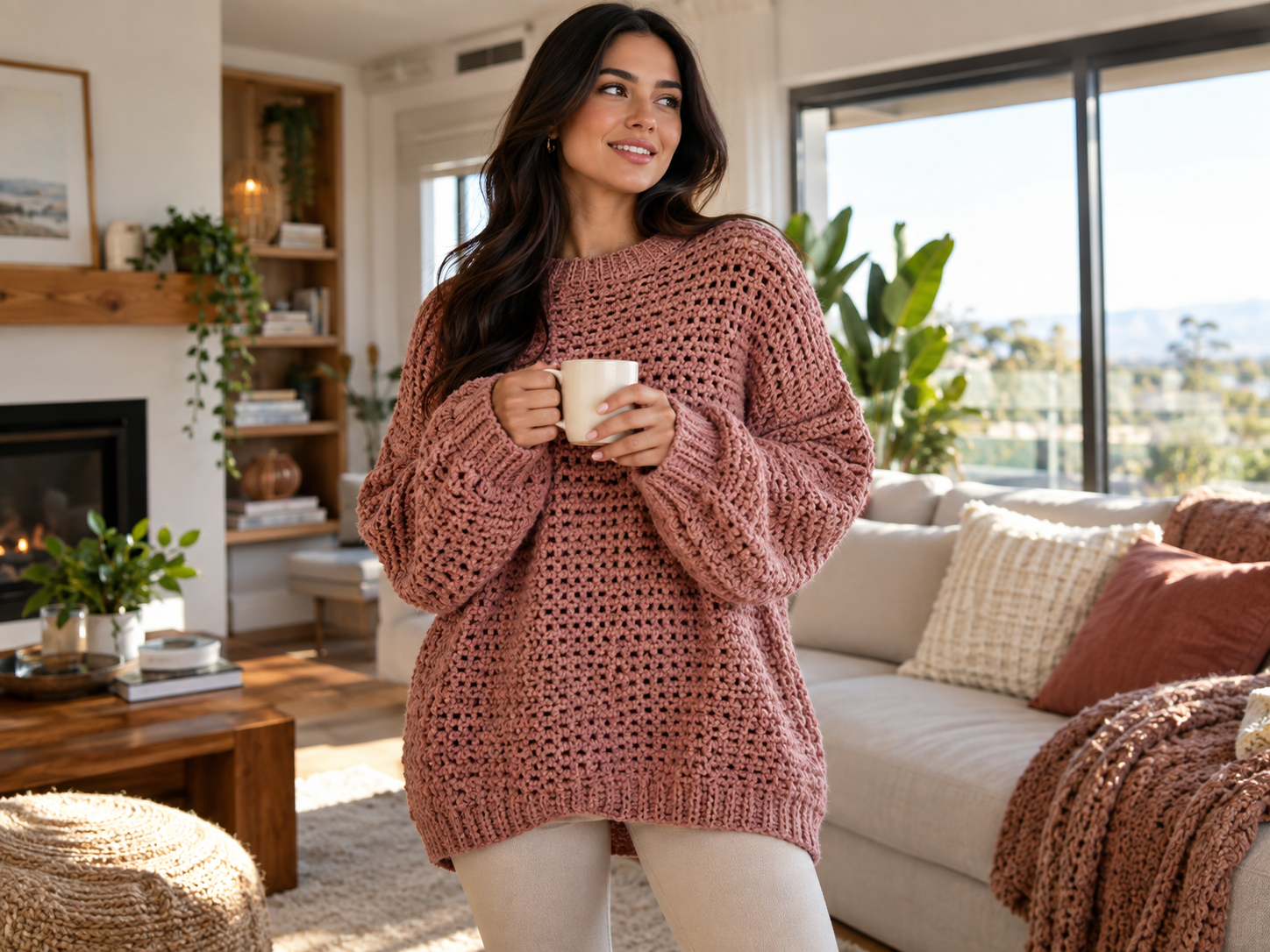
Oversized pullovers are presented as beginner-friendly, size-inclusive designs using worsted-weight yarn. The generous ease (often 6-8 inches) means small gauge variations don’t ruin fit. Drop shoulders eliminate the complex shaping required for set-in sleeves. Minimal waist shaping makes the garment faster to construct.
These designs prioritize wearability and completion rate over tailored fit. For makers intimidated by garment construction, an oversized pullover delivers a finished, wearable sweater with lower risk of fit failure.
Seasonal Search Strategy: When to Start Your Sweater Project
Search interest for crochet sweaters shows strong seasonality, with the lowest reported interest in May 2025 and June 2025 (normalized values of 24 and 25 respectively). Interest increases toward late autumn and winter months when makers plan cold-weather wardrobes.
Start your sweater project in September or October if you want to wear it during the holidays. A 40-50 hour project requires consistent progress over 6-8 weeks, and starting in early fall gives you buffer time for mistakes, re-dos, or slower progress than expected.
Avoid starting complex sweaters in spring when motivation is lowest. Search data shows interest dropping in May-June, which correlates with abandonment rates for long projects. If you start a sweater in April, you may lose motivation by June and never finish.
Summer is ideal for planning, not execution. Use May through August to research patterns, collect materials, and swatch different yarns. Start construction in September when cooler weather renews your motivation to work with wool or acrylic.
Conclusion
The gap between beautiful crochet sweater patterns and execution success comes down to information the pattern should provide but often doesn’t. Size-specific yarn quantities, clear ease explanations, gauge-adjustment instructions, and responsive designer support separate patterns that work from patterns that waste your time.
Made-to-measure construction and flexible-gauge approaches solve the sizing and gauge problems that plague traditional patterns. Worsted-weight yarn remains the accessible standard, but yardage varies too much by size and construction to generalize. Plan your projects in September-October for winter wear, and vet patterns carefully using the green flags and red flags before you buy.
Your next sweater project succeeds when you choose a pattern that respects your time by providing complete, clear information upfront. Demand better patterns, and your success rate will improve dramatically.
Frequently Asked Questions
How much yarn do I need for a crochet sweater in my size?
Exact yardage varies by garment dimensions, ease, stitch density, sleeve length, and construction method. Worsted-weight pullover sweaters typically range from 1,000-1,500 yards for small sizes to 1,800-2,500 yards for plus sizes, but patterns frequently fail to specify amounts by size. Look for patterns that list yardage separately for each size, or calculate conservatively by finding a similar pattern with clear yardage and adding 20% buffer.
What does ease mean in crochet sweater patterns?
Ease is the difference between your body measurements and the finished garment measurements. Fitted sweaters typically use approximately 1 inch of ease, standard-fit sweaters use 2-3 inches, and loose or oversized sweaters use 4+ inches. Forum discussions document that patterns often fail to explain ease, forcing you to guess whether the listed size refers to your body measurement or the finished garment size including ease.
Do I really need to crochet a gauge swatch?
Yes, unless the pattern explicitly uses made-to-measure or flexible-gauge construction that calculates stitch counts from your actual gauge. When your gauge differs from the designer’s specifications, every measurement scales wrong. A pattern calling for 100 stitches across the chest will measure narrower if you crochet tighter or wider if you crochet looser. Crochet your swatch in the actual stitch pattern of the sweater and block it the same way you’ll block the finished garment.
What makes a crochet sweater pattern beginner-friendly?
Beginner-friendly patterns use worsted-weight yarn, simple stitch patterns (primarily single crochet, half-double crochet, or double crochet), minimal shaping, and clear instructions with size-specific yardage. Oversized pullovers with drop shoulders eliminate complex armhole and sleeve-cap shaping. Made-to-measure patterns are increasingly accessible because they calculate from your measurements rather than requiring you to navigate complex size charts.
When should I start a crochet sweater project?
Start in September or October if you want to wear the sweater during winter. Search interest for crochet sweaters drops to its lowest in May-June (normalized values of 24-25) and increases toward late autumn and winter. A typical sweater requires 40-50 hours over 6-8 weeks, so starting in early fall gives you buffer time for mistakes or slower progress. Avoid starting complex sweaters in spring when motivation is lowest.
{
"@context": "https://schema.org",
"@type": "FAQPage",
"mainEntity": [
{
"@type": "Question",
"name": "How much yarn do I need for a crochet sweater in my size?",
"acceptedAnswer": {
"@type": "Answer",
"text": "Exact yardage varies by garment dimensions, ease, stitch density, sleeve length, and construction method. Worsted-weight pullover sweaters typically range from 1,000-1,500 yards for small sizes to 1,800-2,500 yards for plus sizes, but patterns frequently fail to specify amounts by size. Look for patterns that list yardage separately for each size, or calculate conservatively by finding a similar pattern with clear yardage and adding 20% buffer."
}
},
{
"@type": "Question",
"name": "What does ease mean in crochet sweater patterns?",
"acceptedAnswer": {
"@type": "Answer",
"text": "Ease is the difference between your body measurements and the finished garment measurements. Fitted sweaters typically use approximately 1 inch of ease, standard-fit sweaters use 2-3 inches, and loose or oversized sweaters use 4+ inches. Forum discussions document that patterns often fail to explain ease, forcing you to guess whether the listed size refers to your body measurement or the finished garment size including ease."
}
},
{
"@type": "Question",
"name": "Do I really need to crochet a gauge swatch?",
"acceptedAnswer": {
"@type": "Answer",
"text": "Yes, unless the pattern explicitly uses made-to-measure or flexible-gauge construction that calculates stitch counts from your actual gauge. When your gauge differs from the designer's specifications, every measurement scales wrong. A pattern calling for 100 stitches across the chest will measure narrower if you crochet tighter or wider if you crochet looser. Crochet your swatch in the actual stitch pattern of the sweater and block it the same way you'll block the finished garment."
}
},
{
"@type": "Question",
"name": "What makes a crochet sweater pattern beginner-friendly?",
"acceptedAnswer": {
"@type": "Answer",
"text": "Beginner-friendly patterns use worsted-weight yarn, simple stitch patterns (primarily single crochet, half-double crochet, or double crochet), minimal shaping, and clear instructions with size-specific yardage. Oversized pullovers with drop shoulders eliminate complex armhole and sleeve-cap shaping. Made-to-measure patterns are increasingly accessible because they calculate from your measurements rather than requiring you to navigate complex size charts."
}
},
{
"@type": "Question",
"name": "When should I start a crochet sweater project?",
"acceptedAnswer": {
"@type": "Answer",
"text": "Start in September or October if you want to wear the sweater during winter. Search interest for crochet sweaters drops to its lowest in May-June (normalized values of 24-25) and increases toward late autumn and winter. A typical sweater requires 40-50 hours over 6-8 weeks, so starting in early fall gives you buffer time for mistakes or slower progress. Avoid starting complex sweaters in spring when motivation is lowest."
}
}
]
}
Leave a Reply