







crochet newborn blanket patterns can be a satisfying next step after a dishcloth, scarf, or first swatch, but a blanket asks you to repeat skills for much longer. Choose a pattern that fits your current confidence, plan materials and time before you begin, and treat the finished blanket as a handmade textile rather than a sleep accessory.
Key Takeaways
- Build toward a blanket in stages, and make a short test section before committing to all the rows.
- Use published pattern details for gauge, yarn quantity, hook, stitch count, and finished dimensions. Time ranges are planning estimates, not promises.
- Craft size conventions do not establish infant sleep safety. Check current pediatric guidance and use a loose blanket only in an appropriate supervised context.
From a Starter Project to Your First Blanket
A first blanket is not just a larger dishcloth. It asks you to manage a full width of stitches, count rows, keep the edges consistent, and maintain a repeated motion over many sessions. A staged progression makes those demands easier to learn. A guide to avoiding costly crochet pattern mistakes also explains why checking pattern details before you commit can save time and materials.
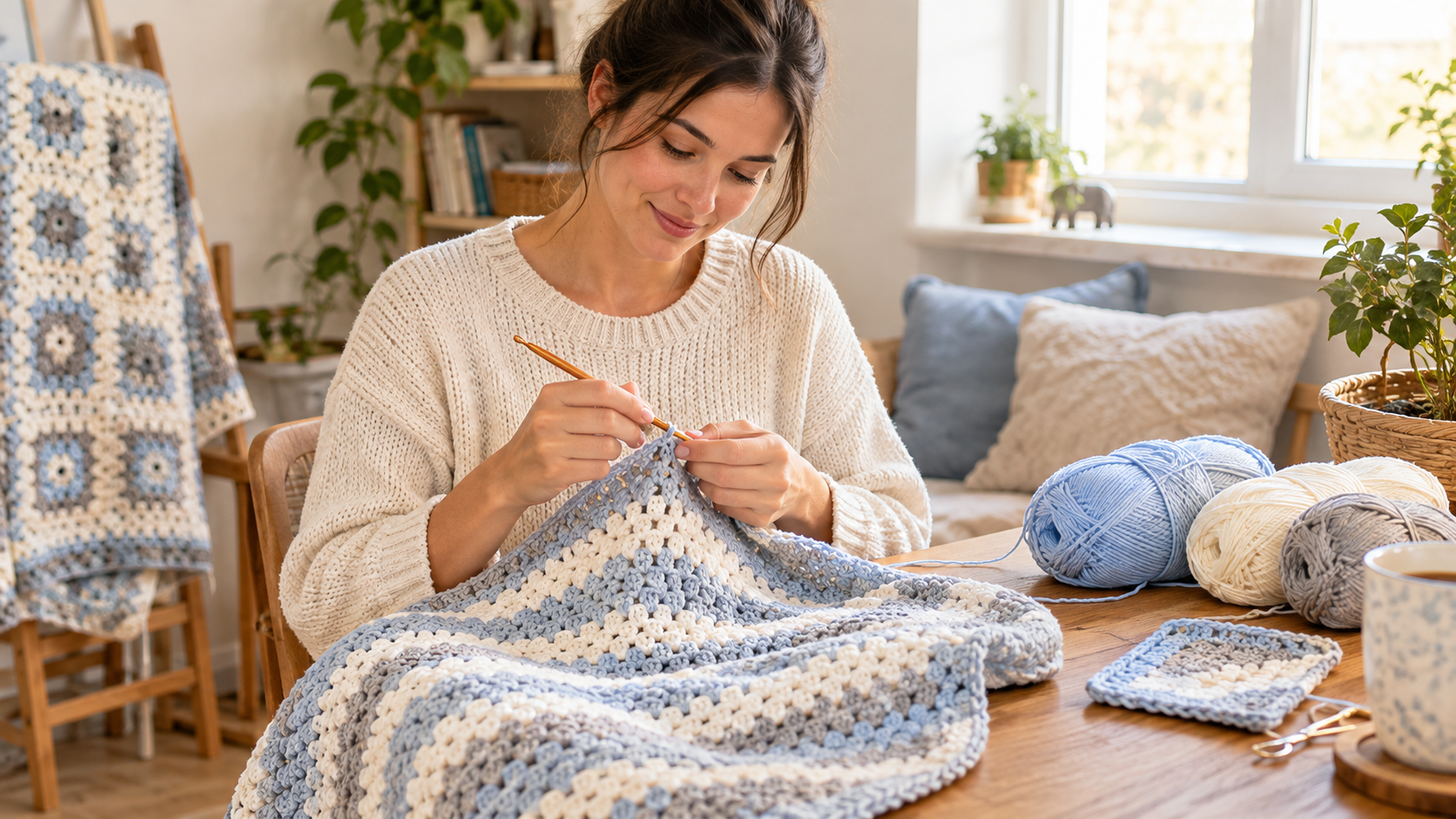
Start with a small swatch or dishcloth to practice chaining, turning, and tension. Move to a small rectangle or scarf to work on row counting and straight edges. A baby blanket in double crochet or half double crochet is the most direct bridge to a larger project: it adds sustained repetition and full width row management without requiring many new stitches. A throw or modular granny blanket can come later, when you are ready to plan more yarn, join pieces, add a border, and support a heavier project.
Choose a Pattern That Matches Your Confidence
Pattern choice is about the kind of attention a design requires, not just whether the stitch is called beginner friendly. A plain double crochet rectangle uses one main stitch and teaches foundation chain management and even edges. Half double crochet makes a compact, repetitive fabric. Moss stitch repeats a simple placement rhythm and asks you to work into chain spaces. Granny squares let you complete small units separately, while adding joining and end weaving. Ripple or chevron designs look distinctive but require careful repeat counting and increases or decreases.
| Construction | What it practices | Planning time |
|---|---|---|
| Double crochet baby blanket | Full width rows, turning chains, edge control | 15 to 35 hours |
| Half double crochet baby blanket | Even tension and identifying top loops | 20 to 40 hours |
| Moss stitch baby blanket | Chain spaces and a repeating rhythm | 20 to 45 hours |
| Granny square blanket | Motifs, joining, and weaving ends | 25 to 70 hours |
| Baby ripple blanket | Pattern repeats, increases, and decreases | 25 to 50 hours |
These estimates are practical planning ranges, not standardized measurements. Your pace changes with stitch density, hook, experience, interruptions, color changes, and finishing work. If you want the simplest first full width project, choose the double crochet rectangle. If you enjoy finishing small pieces, modular squares may feel more manageable even though joining adds work.
What 2026 Interest Data Can Tell You
Broad crochet blanket interest appears strong, but the available trend findings do not verify a separate search volume for the exact phrases “crochet newborn blanket patterns” and “beginner crochet blanket pattern.” One report gives the broad term “crochet blanket” a normalized interest peak of 100 in February 2026. Another records a peak of 85 in January 2026. An Etsy oriented analysis reports more than 1 million monthly crochet related searches and a 22 percent increase from 2025 to 2026.
Those figures describe broad categories, not demand for either exact keyword. Use them as general context, not as proof that a specific pattern will be popular or easy to find. Readers comparing styles may also find the heirloom crochet newborn blanket guide useful for thinking through stitch character and project planning.
Plan Size, Yarn, Hook, and Cost
Choose the intended use and finished size before buying yarn. Common craft conventions include 30 to 36 inches square for a small baby blanket, 36 to 40 inches square for a larger receiving blanket, and 45 to 50 by 60 to 70 inches for a lap or throw. These are familiar project dimensions, not official standards. The pattern itself is the authority for its intended finished size.
Worsted weight is common for standard blankets. Bulky or chunky yarn can make a throw work up faster, but the resulting blanket may be heavier. DK or light worsted can suit a smaller, lighter baby blanket. Fiber, stitch density, border, and dimensions all affect the amount required. Before purchasing, check the pattern’s yarn weight, fiber, skein yardage and count, hook, gauge, stitch multiple, border, and finished measurements. The yarn buying guide covers how fiber, weight, labels, and gauge affect a project.
Do not treat general quantity or cost tables as verified specifications for a named pattern. The research offers planning ranges only and no independently audited material price index. Calculate skeins from the pattern’s total yardage and the yardage per skein, then price the number of skeins you must actually buy. Check whether the stated amount includes swatching and the border.
Read the Pattern and Keep Edges Straight
Before crocheting, read the materials, gauge, finished size, abbreviations, and construction notes. Identify where the first stitch goes and where the row ends. Read repeat marks inside parentheses, brackets, or asterisks as a unit, following the pattern’s own wording. Confirm whether the turning chain counts as a stitch; patterns differ, so do not assume.
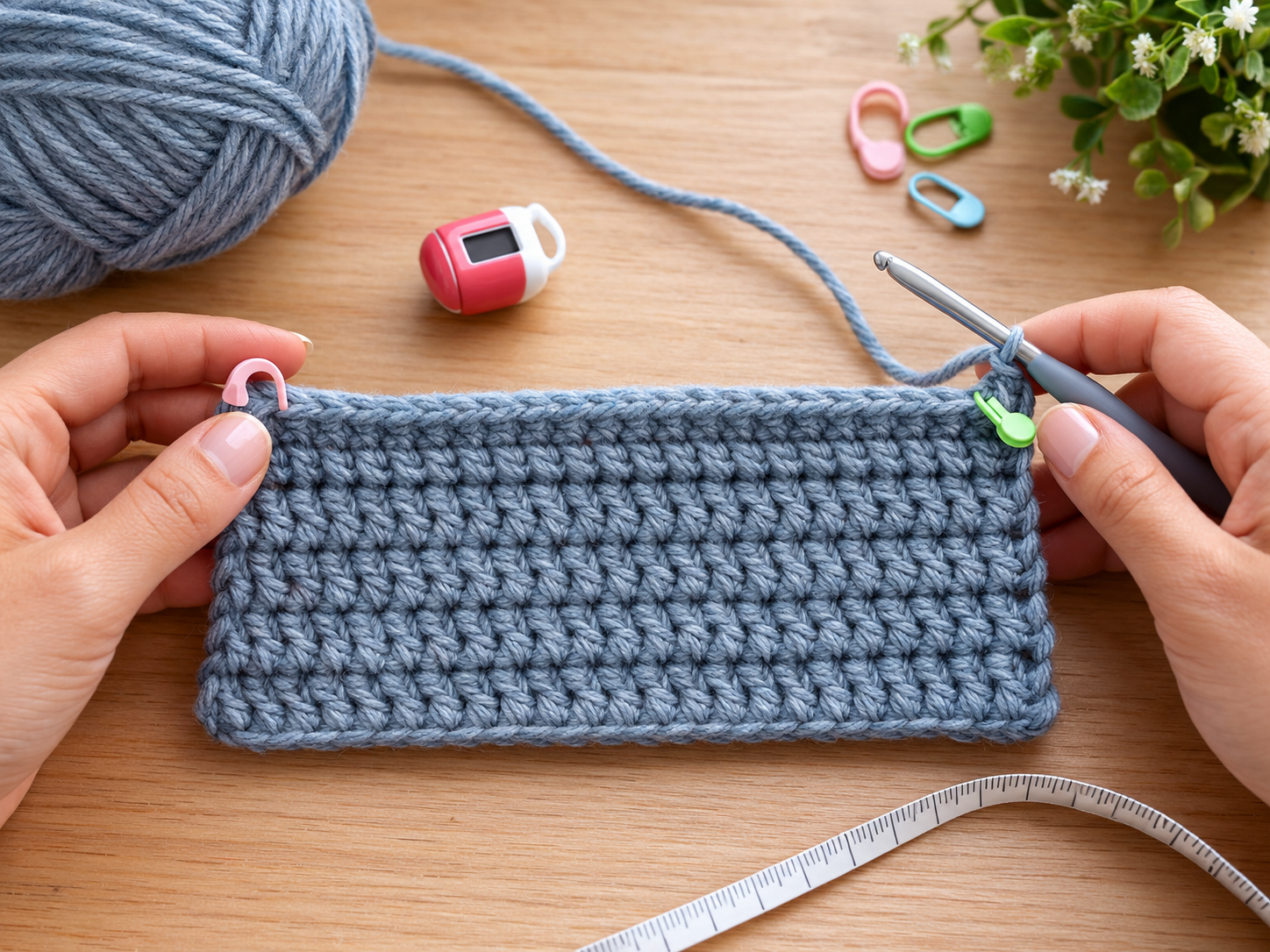
Make a 10 row test section before starting the blanket. It gives you a chance to check fabric, width, pattern rhythm, and your understanding of the row instructions. Count after every row, especially during the first 10 rows. These checks help catch issues early but cannot guarantee every error will be noticed.
Look for the top V of the previous row before inserting the hook, and distinguish a chain space from the stitch beside it. Avoid tightening the first and last stitch. Measure the width periodically instead of waiting until the blanket is finished. Use a chart or tutorial alongside written directions when the pattern provides one.
Fix Mistakes Before They Spread
Unraveling a few stitches is a normal correction, not evidence that you should abandon the project. If you spot an error in the current row, pull back the working loop and frog, or rip out, to the mistake. If a previous row has the wrong count or edge and later rows repeat that problem, unravel to the affected row rather than trying to hide a changing stitch count in the rows above.
Pause and compare your work with the pattern before beginning the next row. Mark first, last, and repeat positions to make the structure easier to see. If you discover a small internal error much later, assess whether it changes the edge, count, or visible repeat. An unobtrusive internal irregularity may not need the same response as a missing edge stitch or a broken repeat. No quantified error rate is available, so use your judgment and the pattern’s stated counts.
Make a Long Project Comfortable and Finishable
Blankets can take longer than a small project and use enough yarn to make the budget feel real. Estimated throw times illustrate the scale: 35 to 80 hours for double crochet, 45 to 90 hours for half double crochet, 50 to 100 hours for moss stitch, and 60 to 120 hours for ripple. These are estimates, not a deadline or promise. Joining, color changes, ends, borders, and blocking add time.
Choose a baby or lap size first, use a simple repeat, calculate yardage before shopping, and set a modest weekly row target. Support the weight of a growing blanket on your lap or a nearby surface. Change position, take regular breaks, keep a relaxed grip, and stop if pain develops. These are risk reduction practices, not treatment or a guarantee against discomfort. Reviewed sources do not provide blanket specific clinical trials quantifying injury rates, or a standardized audited price index for blanket materials.
For another practical project check, read the baby blanket pattern planning guide before you commit to yarn and dimensions.
Newborn Blanket Dimensions and Safe Use
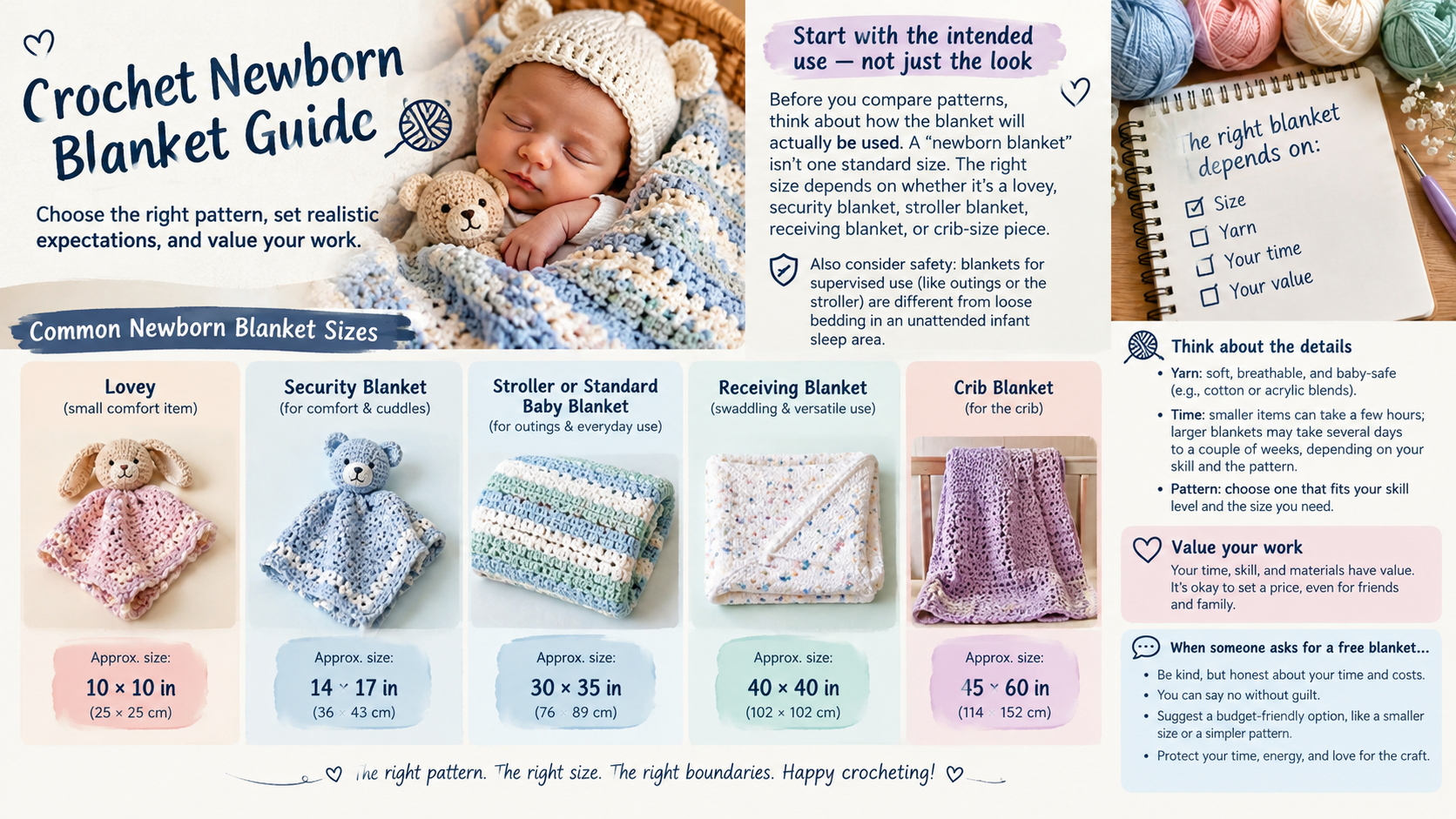
Craft conventions describe small lovey or security blankets as about 12 to 18 inches square, receiving blankets as about 30 to 36 inches square, and larger baby blankets as about 36 to 40 inches square. The gathered research does not establish one universal official newborn blanket size. A dimension used by a pattern is not proof that a blanket is suitable for unsupervised infant sleep.
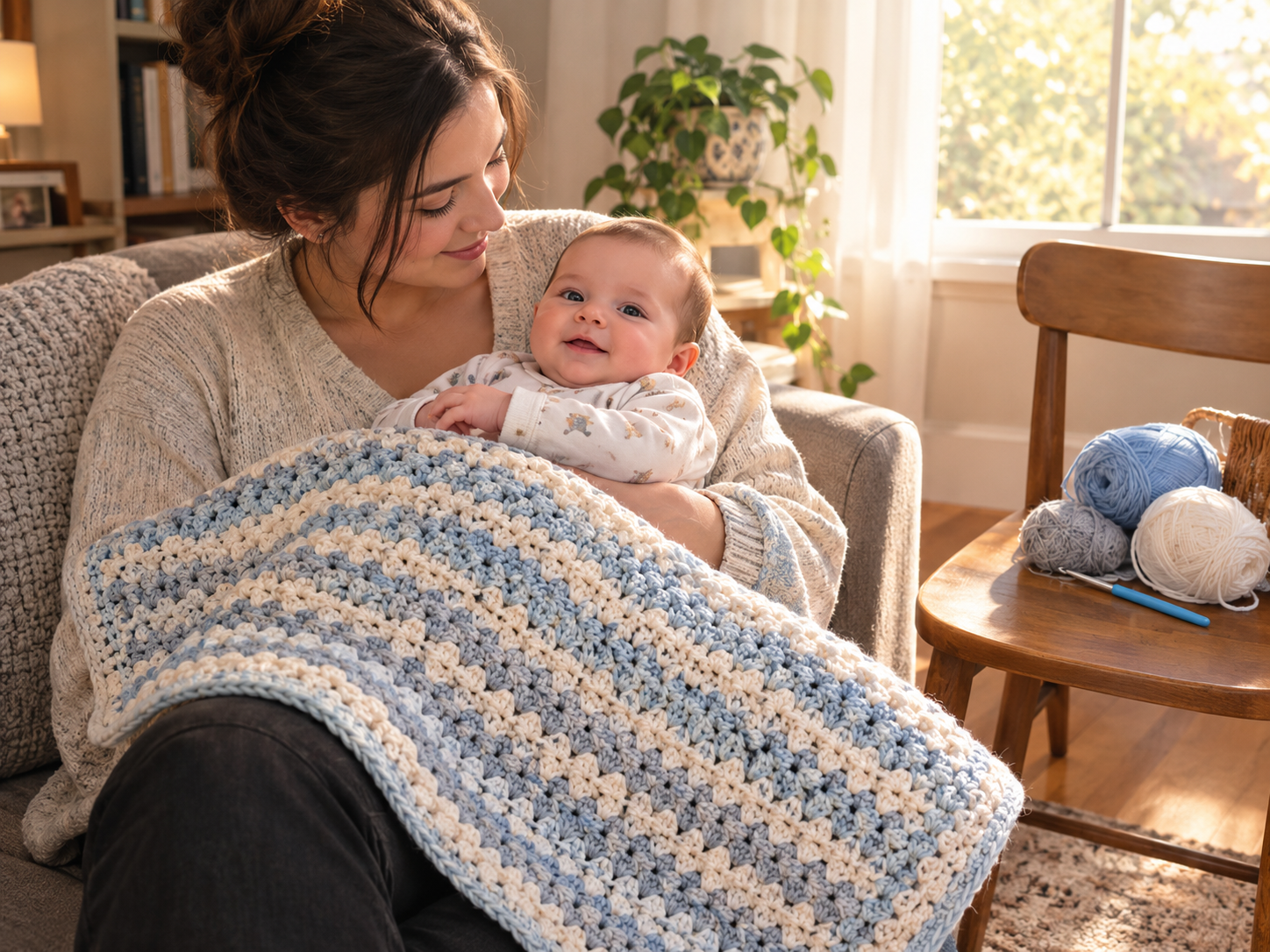
A crochet blanket is still a loose textile. Do not present it as an unsupervised newborn sleep accessory. Check current advice from the American Academy of Pediatrics safe sleep guidance and the CDC infant safe sleep guidance before publication and follow current recommendations for use.
For a handmade blanket, weave ends in securely, select washable and colorfast yarn, and inspect the fabric after washing. Avoid loose buttons, beads, detachable appliqués, long fringe, unsecured decorative elements, and openings that could catch fingers or toes. These construction checks do not guarantee safety. For more practical detail, see the crochet baby blanket safety guide.
A Realistic Finish Line Checklist
- Choose a pattern with a clear repeat and stated stitch counts.
- Confirm gauge, hook, yarn details, and finished dimensions in the original pattern.
- Calculate the required yardage and check whether the border is included.
- Make a 10 row test section and measure its width.
- Mark the row edges, right side, and repeat positions.
- Set a sustainable schedule and support the blanket’s weight while working.
- Inspect the finished fabric, joins, and woven ends before use.
Worsted yarn is common for standard blankets, bulky yarn can speed a throw at the cost of extra weight, and DK or light worsted can make a smaller, lighter baby project. Double crochet, half double crochet, granny clusters, moss stitch, and simple ripple repeats are all possible beginner constructions. Choose the one whose counting and finishing demands feel manageable now.
Conclusion
Your first blanket becomes more manageable when you build up from a smaller project, choose a clear stitch repeat, count early rows, and plan realistic time and materials. Fix errors thoughtfully, take breaks, and verify newborn use against current pediatric guidance rather than assuming size alone makes a blanket safe.
Choose one pattern, check its original specifications, and make your 10 row test section this week. Use these crochet newborn blanket patterns as a starting point for a considered, achievable project.
Frequently Asked Questions
What is the easiest crochet stitch for a first baby blanket?
A plain double crochet rectangle is a direct first full size project because it uses one main stitch while teaching full width row management. Half double crochet is another repetitive option. Follow the chosen pattern’s turning chain instructions and stitch counts.
How long does a crochet baby blanket take?
Planning ranges in the research are 15 to 35 hours for a double crochet baby blanket, 20 to 40 for half double crochet, 20 to 45 for moss stitch, 25 to 70 for granny squares, and 25 to 50 for a baby ripple. Actual time varies with pace, interruptions, pattern density, and finishing.
What size should a crochet newborn blanket be?
Common craft conventions include 12 to 18 inches square for small loveys, 30 to 36 inches square for receiving blankets, and 36 to 40 inches square for larger baby blankets. These are not a universal official standard and do not establish safe use for infant sleep.
How can I keep blanket edges straight?
Check the pattern’s turning chain rule, mark the first and last stitch, count each row, especially the first 10, and measure width from time to time. Make a 10 row test section to check your understanding before working the full project.
Can a newborn sleep with a handmade crochet blanket?
Do not treat a loose crochet blanket as an unsupervised sleep accessory. Check current pediatric or public health safe sleep guidance for how and when blankets may be used. Secure ends and avoid loose decorations, but remember that construction checks do not guarantee sleep safety.
{"@context":"https://schema.org","@type":"FAQPage","mainEntity":[{"@type":"Question","name":"What is the easiest crochet stitch for a first baby blanket?","acceptedAnswer":{"@type":"Answer","text":"A plain double crochet rectangle is a direct first full size project because it uses one main stitch while teaching full width row management. Half double crochet is another repetitive option. Follow the chosen pattern’s turning chain instructions and stitch counts."}},{"@type":"Question","name":"How long does a crochet baby blanket take?","acceptedAnswer":{"@type":"Answer","text":"Planning ranges in the research are 15 to 35 hours for a double crochet baby blanket, 20 to 40 for half double crochet, 20 to 45 for moss stitch, 25 to 70 for granny squares, and 25 to 50 for a baby ripple. Actual time varies with pace, interruptions, pattern density, and finishing."}},{"@type":"Question","name":"What size should a crochet newborn blanket be?","acceptedAnswer":{"@type":"Answer","text":"Common craft conventions include 12 to 18 inches square for small loveys, 30 to 36 inches square for receiving blankets, and 36 to 40 inches square for larger baby blankets. These are not a universal official standard and do not establish safe use for infant sleep."}},{"@type":"Question","name":"How can I keep blanket edges straight?","acceptedAnswer":{"@type":"Answer","text":"Check the pattern’s turning chain rule, mark the first and last stitch, count each row, especially the first 10, and measure width from time to time. Make a 10 row test section to check your understanding before working the full project."}},{"@type":"Question","name":"Can a newborn sleep with a handmade crochet blanket?","acceptedAnswer":{"@type":"Answer","text":"Do not treat a loose crochet blanket as an unsupervised sleep accessory. Check current pediatric or public health safe sleep guidance for how and when blankets may be used. Secure ends and avoid loose decorations, but remember that construction checks do not guarantee sleep safety."}}]}
Leave a Reply