


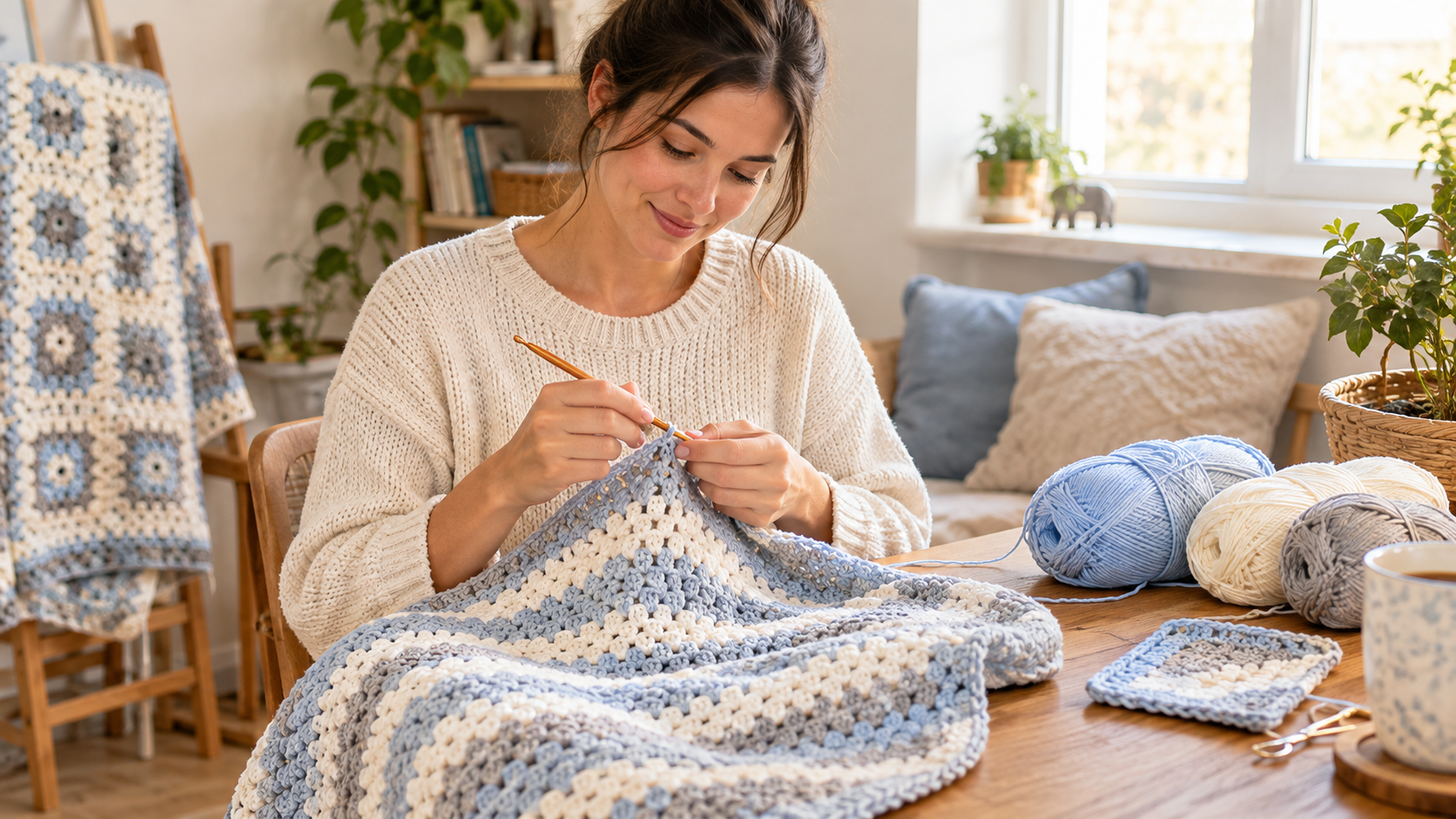



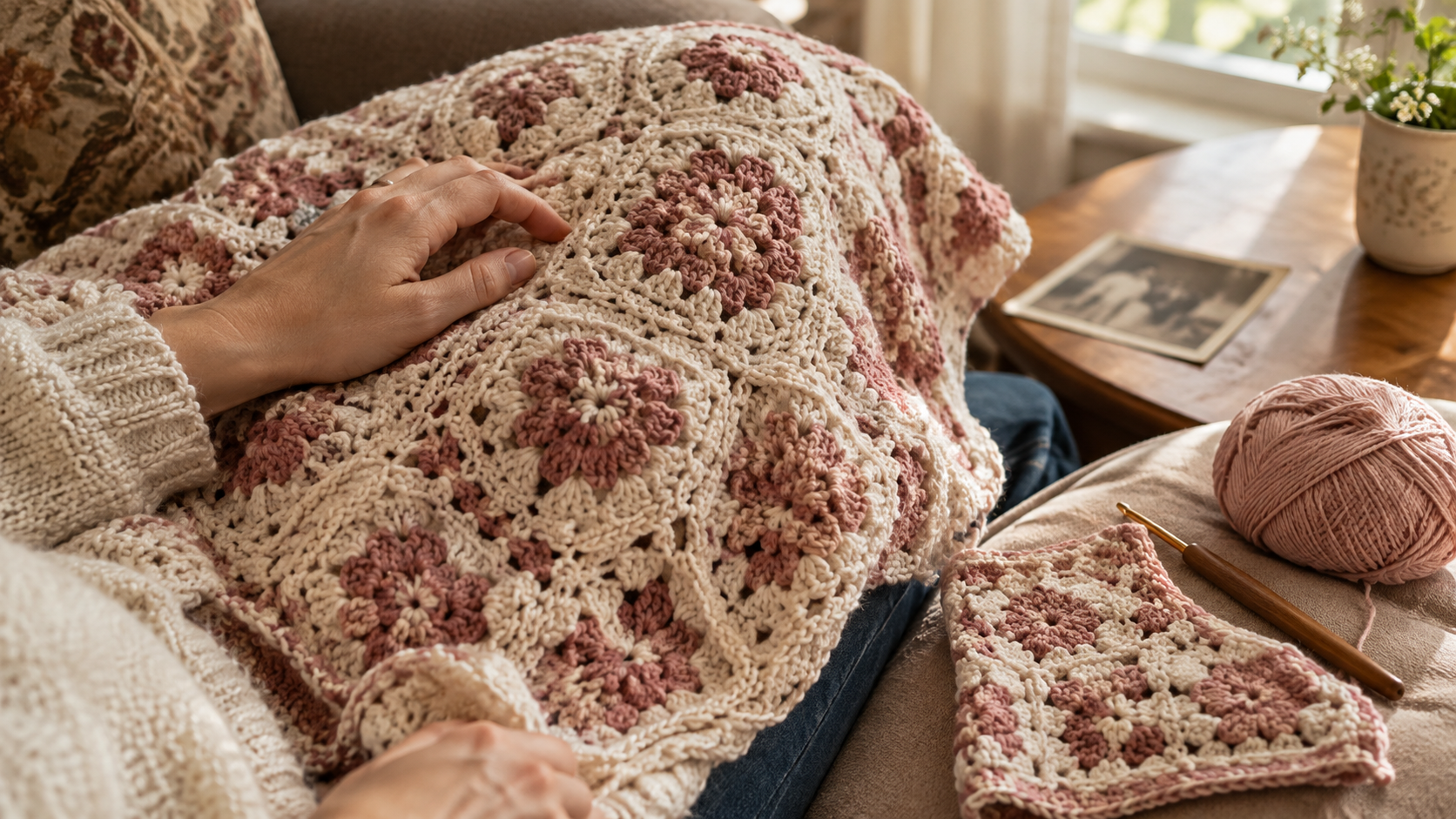


crochet newborn blanket patterns may be what you searched for, but if an old blanket carries family memories, the first decision is whether it can be handled and repaired safely. A new blanket can be a companion for a baby; it cannot replace the original maker, history, or familiar feel.
Key Takeaways
- Start with gentle observation and photographs. Do not pull, wash, or test fragile yarn with a needle.
- A repair depends on whether the original yarn around the damage can hold new tension. No visual check can guarantee success.
- If regular use is no longer safe, discuss display or keepsake options and approve every irreversible step in advance.
The preservation first decision
A blanket with a hole is not automatically beyond repair, and a neat looking surface does not prove that its yarn is strong. The important question is whether the original stitches beside the damaged area can hold the tension of new stitches. A stable, localized hole may suit darning or a replacement motif. If the yarn crumbles, snaps, or sheds with light handling, ordinary crochet repair may pull more fabric apart.
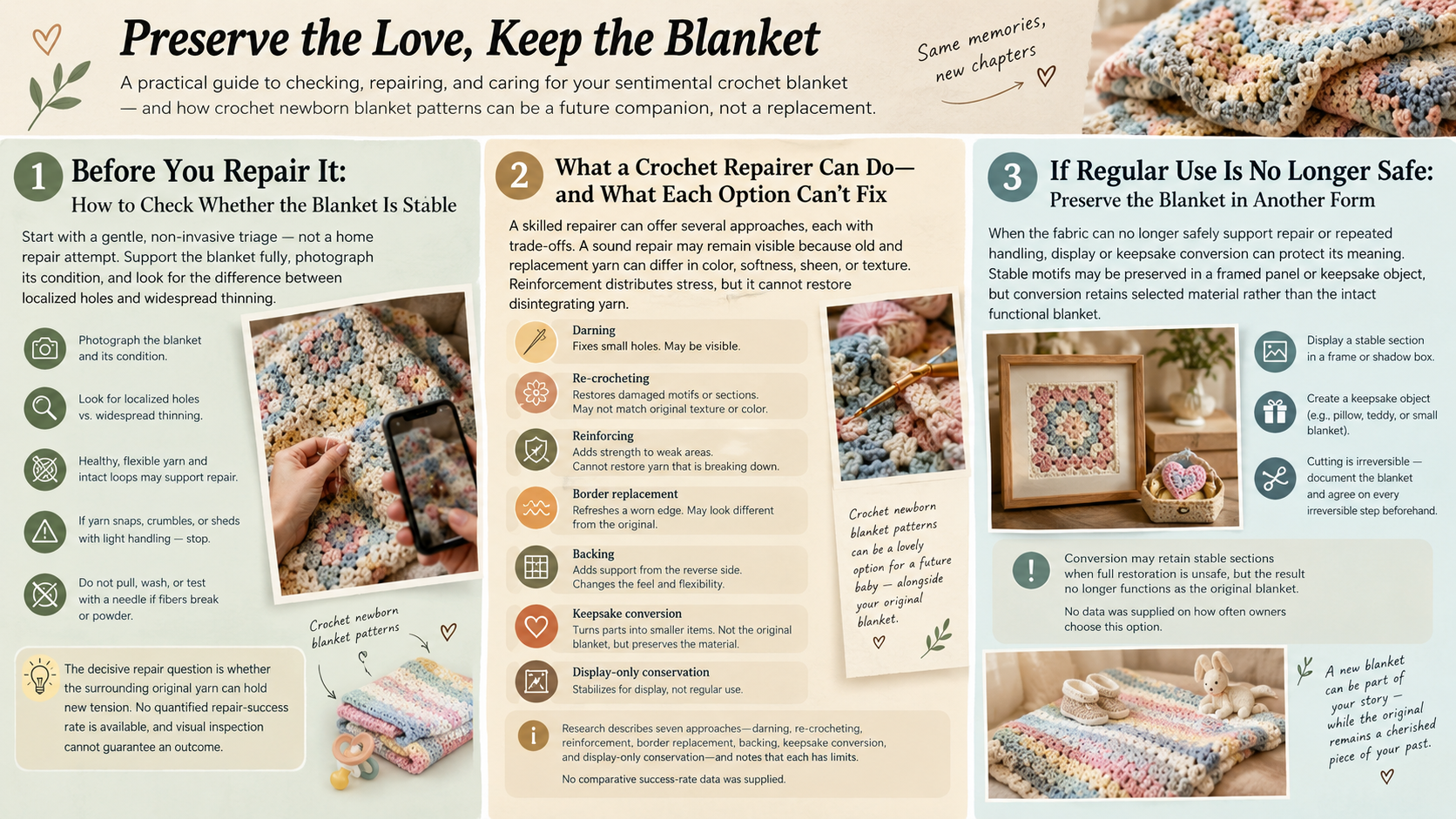
Think of the first check as triage, not a repair test. You do not need crochet experience to notice thinning, loose joins, discoloration, or broken loops. You do need to avoid actions that put stress on a fragile textile. If you see powder, broken fibers, or a section opening as it is moved, stop and seek an experienced crochet repairer or textile conservator.
That preservation question is different from choosing a new pattern. Pattern interest does not measure repair demand, and making a second blanket should never be presented as a replacement for a keepsake.
Step by step safe assessment
Use a slow, non invasive process to record what you can see without forcing the blanket to prove its strength. Keep it fully supported throughout.
- Prepare a clean surface. Cover a dry table with a clean sheet or white cotton cloth. Wash and dry your hands, and avoid handling immediately after applying lotion.
- Support the whole blanket. Do not lift it by one corner or edge. If it is heavy, slide a clean support underneath rather than dragging it.
- Photograph before handling. Take clear pictures of both sides, borders, labels, stains, loose threads, holes, and thin areas. These photographs create a condition record for you and a repairer.
- Look under neutral light. Note whether damage is limited to one hole or appears in multiple areas. Check joins, corners, border attachments, and earlier repairs.
- Observe, do not pull. A gentle fingertip stroke can reveal shedding. Do not pinch, tug loose ends, comb the yarn, stretch the fabric, or use a sewing needle to test the loops.
- Stop at signs of breakdown. If fibers snap, powder, or come away with minimal contact, lay the blanket flat or loosely roll it with support and ask a professional what to do next.
Do not wash, wet, heat, glue, or cut the blanket to identify its fiber or test a repair idea. If a detached piece is already present, keep it in a labeled paper envelope for possible identification. Do not cut a sample from intact fabric.
Repair choices and their limits
A repairer may recommend a small intervention, broader stabilization, or preservation without everyday use. Ask what each option protects and what it changes. No comparative success rate was supplied for these approaches, so treat them as choices for assessment, not guaranteed outcomes.
| Approach | May suit | Limit to discuss |
|---|---|---|
| Darning | A small hole or local thinning with stable surrounding loops | The patch may show, and it cannot anchor safely in yarn that breaks easily. |
| Re crocheting a section | A missing square, motif, or damaged join | Replacement yarn may differ in color, fiber, weight, softness, or age. |
| Reinforcement | A weak border, join, or stress point | It redistributes stress but cannot restore strength to disintegrating yarn. |
| Border replacement | A damaged outer edge | It can change proportions and place tension on fragile inner stitches. |
| Backing or lining | A visually important textile too weak for direct handling | It may alter weight, drape, breathability, and familiar texture. |
| Keepsake conversion or display | A blanket that cannot support regular use | Conversion preserves selected material, not the intact original blanket. Cutting is irreversible. |
Exact reconstruction can be difficult even when a matching stitch is identified. The original yarn may have faded, relaxed, or softened with use. A new border or backing may make the object more stable while making it feel less like the blanket you remember. Agree on the goal first: keep it usable, slow further damage, or preserve it with minimal handling.
Choosing a repairer and agreeing on a plan
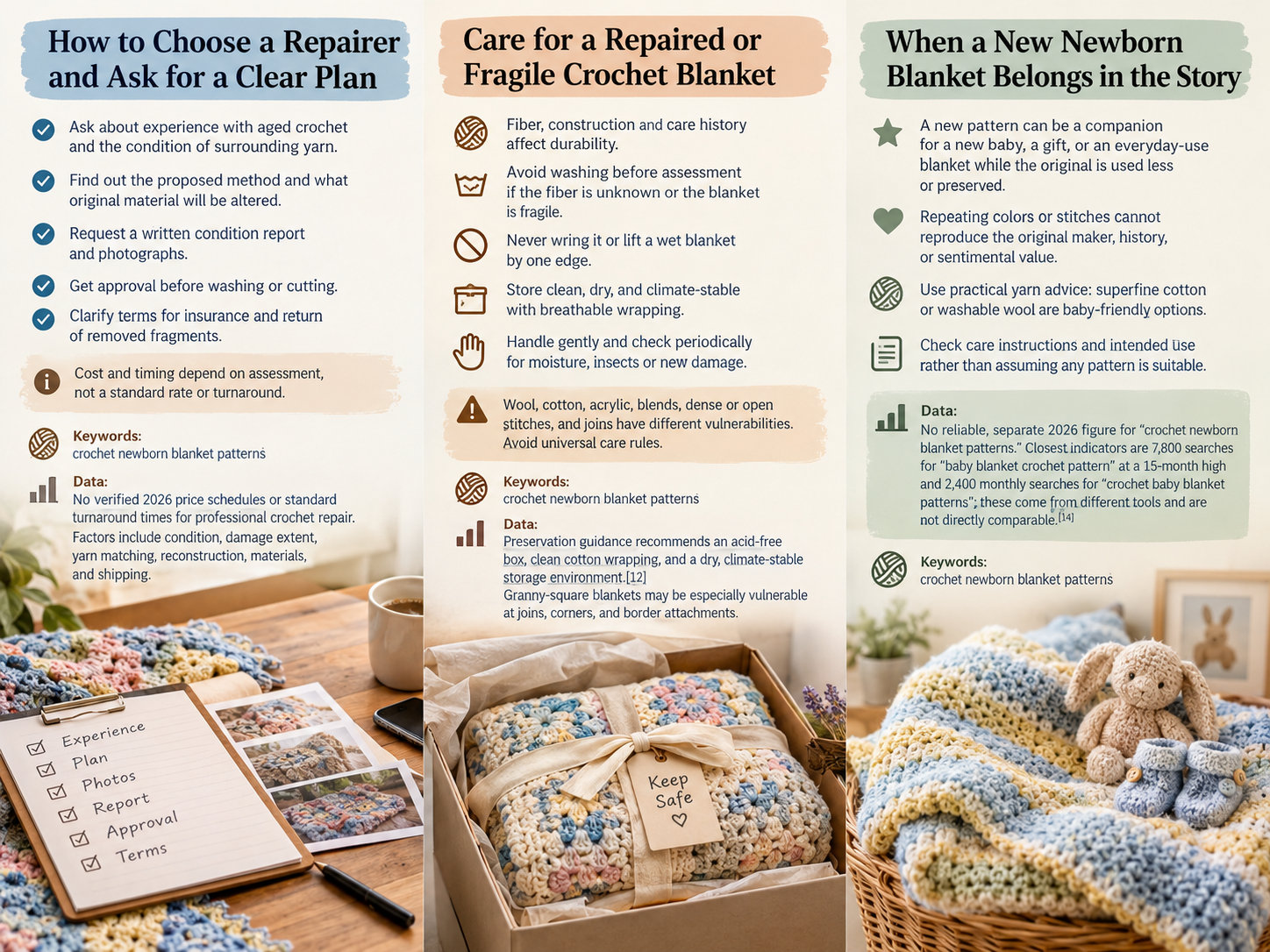
Look for someone with experience in aged crochet, not only modern projects. Ask whether they can assess the surrounding yarn and distinguish a crochet repair from textile conservation. Before authorizing work, request a written condition report, photographs, recommended method, and explanation of which areas are stable, weak, or beyond practical repair.
- Ask what material may be removed, cut, washed, blocked, backed, or re crocheted.
- Agree on acceptable differences in color, sheen, texture, stiffness, and drape.
- Ask whether a yarn sample or small test area is possible before larger work.
- Get a price estimate, materials, shipping, insurance, and a maximum charge that requires your approval.
- Confirm the expected schedule, how the blanket will be stored, and what happens if it proves too fragile.
- Ask for all removed fragments to be returned and get written approval before irreversible steps.
No verified standard 2026 price schedule or turnaround time is available in the supplied research. A quote depends on condition, damage extent, yarn identification and matching, reconstruction, materials, and shipping. An in person or careful hands on assessment may be needed before a firm estimate is possible.
For help thinking through fiber, weight, and care labels, see the yarn guide to fiber, gauge, and cost. If the blanket is intended for an infant, consult the separate crochet baby blanket safety guide as well.
Care for a fragile or repaired blanket
Do not assume every crochet blanket can be washed the same way. Wool can felt with agitation and heat; cotton can weaken after abrasion or repeated wet and dry cycles; acrylic may distort with heat and can become brittle with age. Blends may age unevenly. Stitch construction matters too: open stitches can snag, and granny square blankets may be vulnerable at joins, corners, and border attachments.
If fiber content is unknown and the blanket is old or fragile, defer washing until an experienced professional has assessed it. Never wring or twist it, and never lift a wet blanket by one edge. If a qualified person confirms washing is appropriate, support the whole textile during transfer and dry it flat on a clean absorbent surface when the fiber and condition permit.
Store it clean and completely dry in a dry, climate stable place. Preservation guidance recommends an acid free box with clean cotton wrapping. Avoid plastic that may trap moisture, direct sunlight, radiators, damp basements, and heavy objects on top. Fold with occasional changes in fold position or roll around a wide support. Check periodically for moisture, insects, mold, and new breaks. The Library of Congress textile care guidance offers additional general care information.
When a new newborn blanket belongs in the story
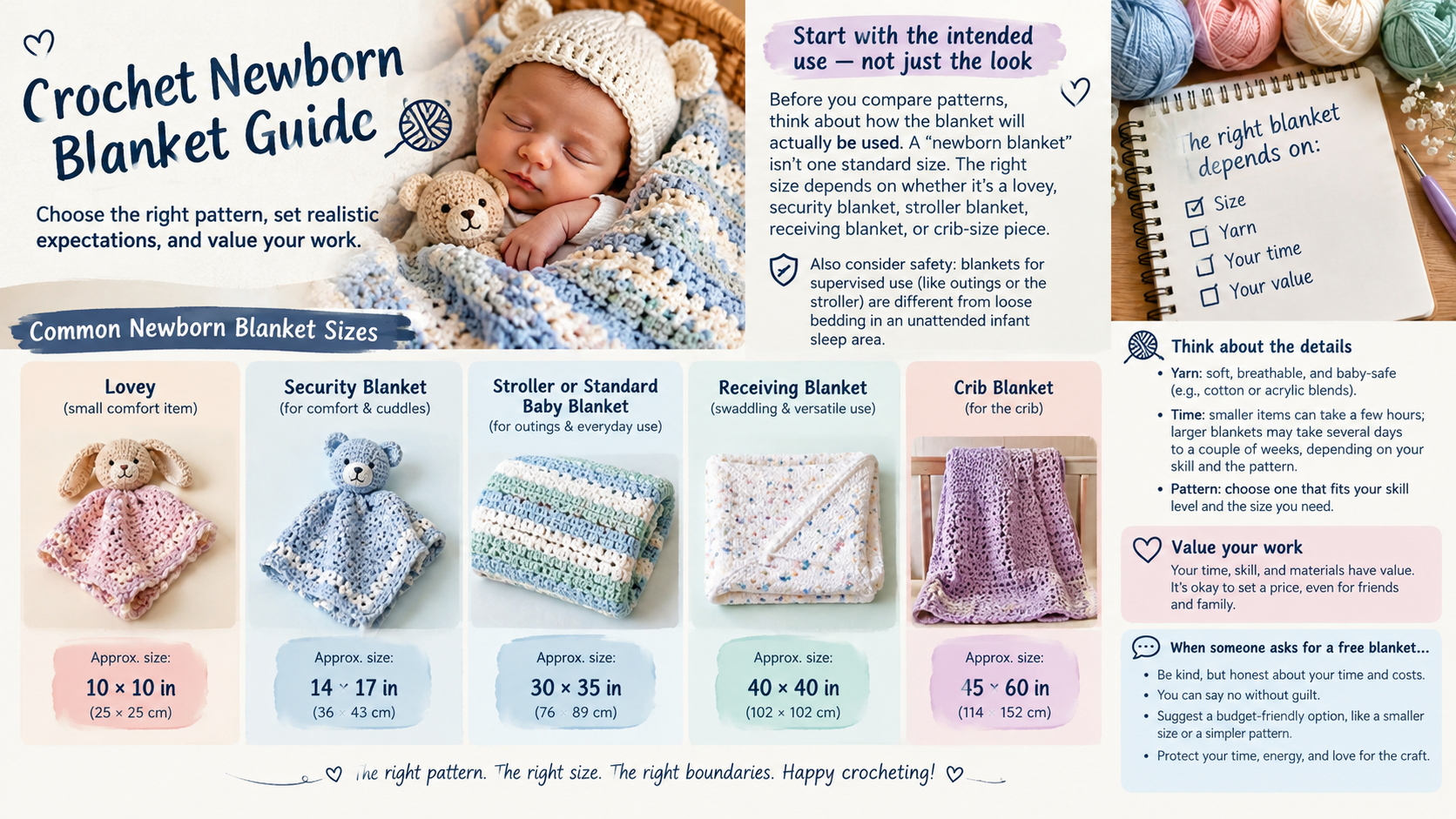
A companion blanket can be a practical choice for a new baby, a gift, or everyday use while the original is handled less or preserved. Repeating a color palette or stitch style may create a thoughtful connection, but it cannot recreate the original maker, history, wear, or emotional meaning.
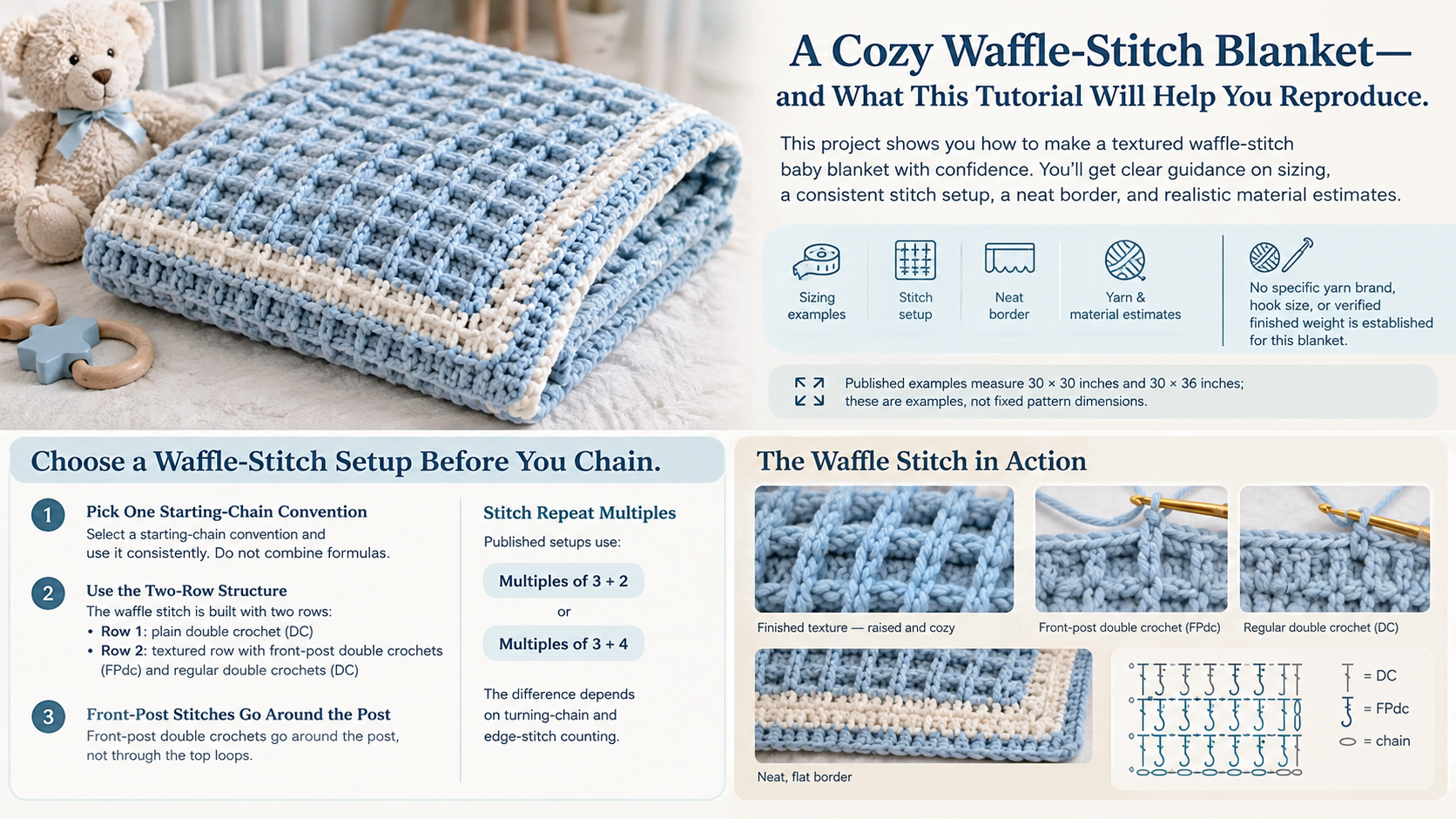
When comparing crochet newborn blanket patterns, keep the choice modest and practical. The crochet knowledge source identifies superfine cotton or washable wool as baby friendly yarn options. Check the yarn label, care instructions, texture, and intended use rather than assuming every pattern or fiber is automatically suitable. For infant sleep safety, follow current safe sleep guidance and keep loose blankets out of an infant sleep space. See the U.S. Consumer Product Safety Commission safe sleep information and the site’s related guide to practical crochet baby gifts.
A new newborn blanket may support continued use while the original is preserved; it does not replace the original blanket’s history or sentimental value.
What search data can tell us
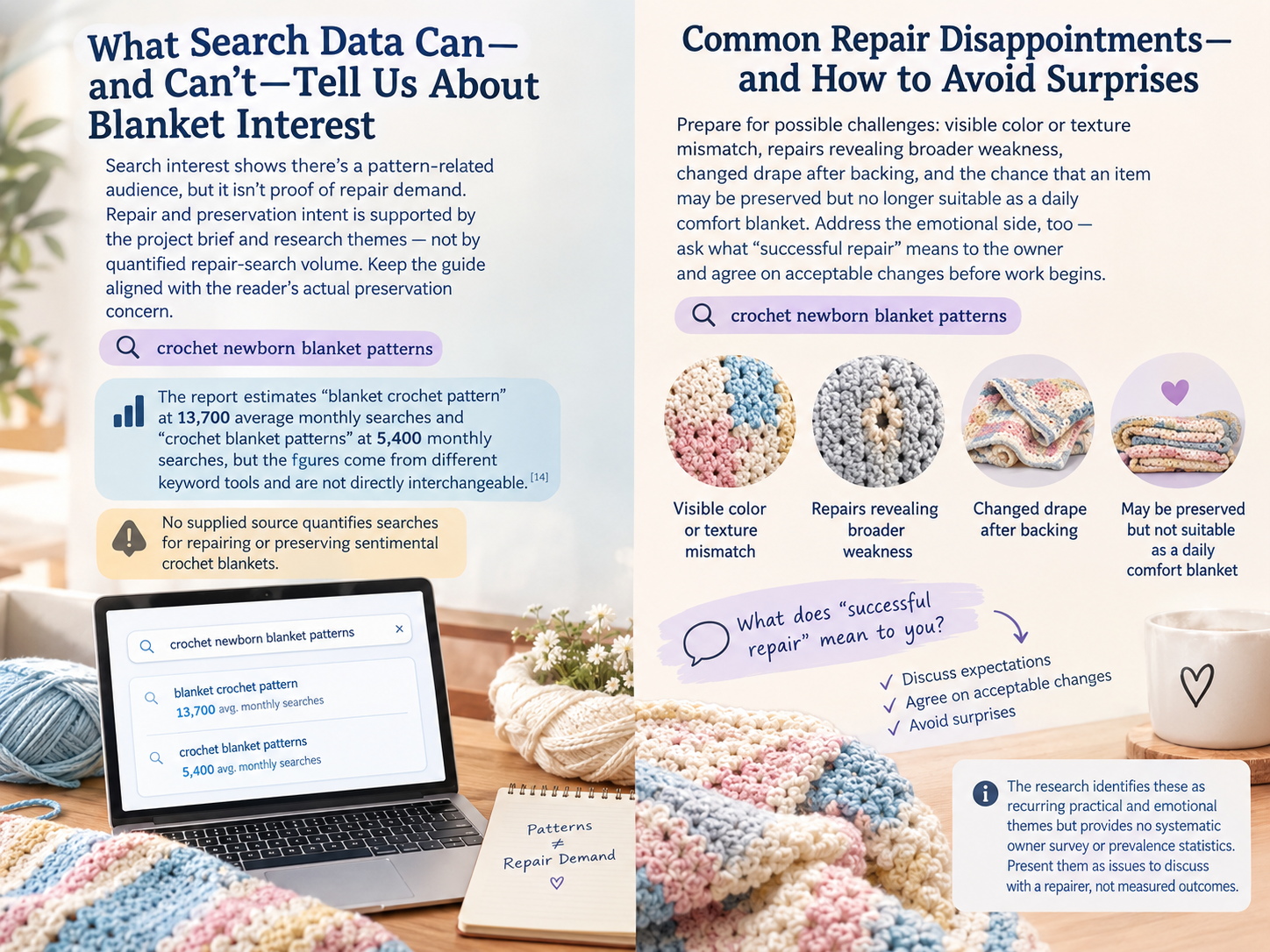
There is no reliable, separately reported 2026 search figure for the exact phrase “crochet newborn blanket patterns” in the supplied research. One dataset reported 7,800 searches for “baby blanket crochet pattern” at a reported 15 month high. Another estimated 2,400 monthly searches for “crochet baby blanket patterns.” These figures come from different tools and should not be compared as though they share a method.
The report also estimates “blanket crochet pattern” at 13,700 average monthly searches and “crochet blanket patterns” at 5,400 monthly searches, again from different keyword tools. Google Trends can help readers explore relative interest over time, but these pattern figures do not quantify demand for repairing sentimental blankets. The supplied data does not measure repair searches or owner experiences.
Common disappointments and ways to prevent them
Set expectations before work begins. A repair may be structurally useful and still visible. Replacement yarn can differ in shade, softness, thickness, or sheen. Once work starts, a small hole may reveal weakness in nearby loops. A backing may stabilize the blanket but change its drape. A blanket can be preserved as a keepsake and still be unsuitable as a daily comfort object.
| Possible surprise | How to reduce uncertainty |
|---|---|
| The repair is more visible than expected | Discuss the desired balance between stability and visual match, and review yarn samples where possible. |
| Damage extends beyond the first hole | Ask the repairer to document newly discovered weak areas and seek approval before expanding the work. |
| Washing or blocking changes the feel | Do not authorize cleaning without discussing risks, fiber, and alternatives. |
| The blanket is too fragile for routine use | Talk about supervised limited use, display, or keepsake conversion before choosing. |
| Conversion involves cutting | Document the blanket and decide in writing which parts may be altered. Cutting cannot be undone. |
These are practical and emotional concerns described in the research, not measured outcomes from an owner survey. Before commissioning work, say what a successful result means to you: a usable blanket, a stable heirloom, or a preserved section. That conversation helps prevent a technically sound repair from feeling like the wrong outcome.
For related project planning, read the baby blanket crochet pattern guide or the guide to checking a baby blanket before donation. Those resources are about new blanket use and planning, not restoration of an aged keepsake.
Conclusion
Photograph and support a sentimental blanket before doing anything else. Repair feasibility depends on the condition of the surrounding yarn, and a professional assessment is more reliable than an at home strength test. Discuss visible changes, costs, care, and every irreversible action in advance. If the original cannot safely support regular use, preservation may mean display or a keepsake rather than full restoration.
A new blanket can be a companion for future use, not a substitute for the original. Explore crochet newborn blanket patterns for a separate project, and begin by documenting the blanket you already value. If it shows signs of shedding or brittleness, stop handling it and contact an experienced repairer or textile conservator.
Frequently asked questions
Can a crochet blanket with a hole always be repaired?
No. A localized hole may be repairable when the yarn around it can hold new tension. If surrounding fibers snap, crumble, or shed with light handling, ordinary spot repair may cause more damage. A visual inspection cannot guarantee success.
Should I wash an old crochet blanket before taking it to a repairer?
Not if it is fragile or the fiber is unknown. Washing, agitation, or lifting a wet blanket incorrectly can distort or damage it. Ask the repairer or a textile professional to assess it first.
Can a repair be invisible?
Not necessarily. Replacement yarn can differ in color, sheen, softness, or texture, and the original may have faded or relaxed. Agree on an acceptable level of visible change before work begins.
What can I do if the blanket is too fragile for normal use?
Discuss display only conservation or keepsake conversion. Stable motifs may be preserved in a framed panel or another object, but conversion retains selected material rather than the intact blanket, and cutting is irreversible.
Does a new newborn blanket replace a sentimental original?
No. A companion blanket can support everyday use while the original is preserved, but a similar color or stitch cannot reproduce its maker, history, or sentimental value. Choose yarn according to its care instructions and intended use.
{"@context":"https://schema.org","@type":"FAQPage","mainEntity":[{"@type":"Question","name":"Can a crochet blanket with a hole always be repaired?","acceptedAnswer":{"@type":"Answer","text":"No. A localized hole may be repairable when the yarn around it can hold new tension. If surrounding fibers snap, crumble, or shed with light handling, ordinary spot repair may cause more damage. A visual inspection cannot guarantee success."}},{"@type":"Question","name":"Should I wash an old crochet blanket before taking it to a repairer?","acceptedAnswer":{"@type":"Answer","text":"Not if it is fragile or the fiber is unknown. Washing, agitation, or lifting a wet blanket incorrectly can distort or damage it. Ask the repairer or a textile professional to assess it first."}},{"@type":"Question","name":"Can a repair be invisible?","acceptedAnswer":{"@type":"Answer","text":"Not necessarily. Replacement yarn can differ in color, sheen, softness, or texture, and the original may have faded or relaxed. Agree on an acceptable level of visible change before work begins."}},{"@type":"Question","name":"What can I do if the blanket is too fragile for normal use?","acceptedAnswer":{"@type":"Answer","text":"Discuss display only conservation or keepsake conversion. Stable motifs may be preserved in a framed panel or another object, but conversion retains selected material rather than the intact blanket, and cutting is irreversible."}},{"@type":"Question","name":"Does a new newborn blanket replace a sentimental original?","acceptedAnswer":{"@type":"Answer","text":"No. A companion blanket can support everyday use while the original is preserved, but a similar color or stitch cannot reproduce its maker, history, or sentimental value. Choose yarn according to its care instructions and intended use."}}]}
Leave a Reply